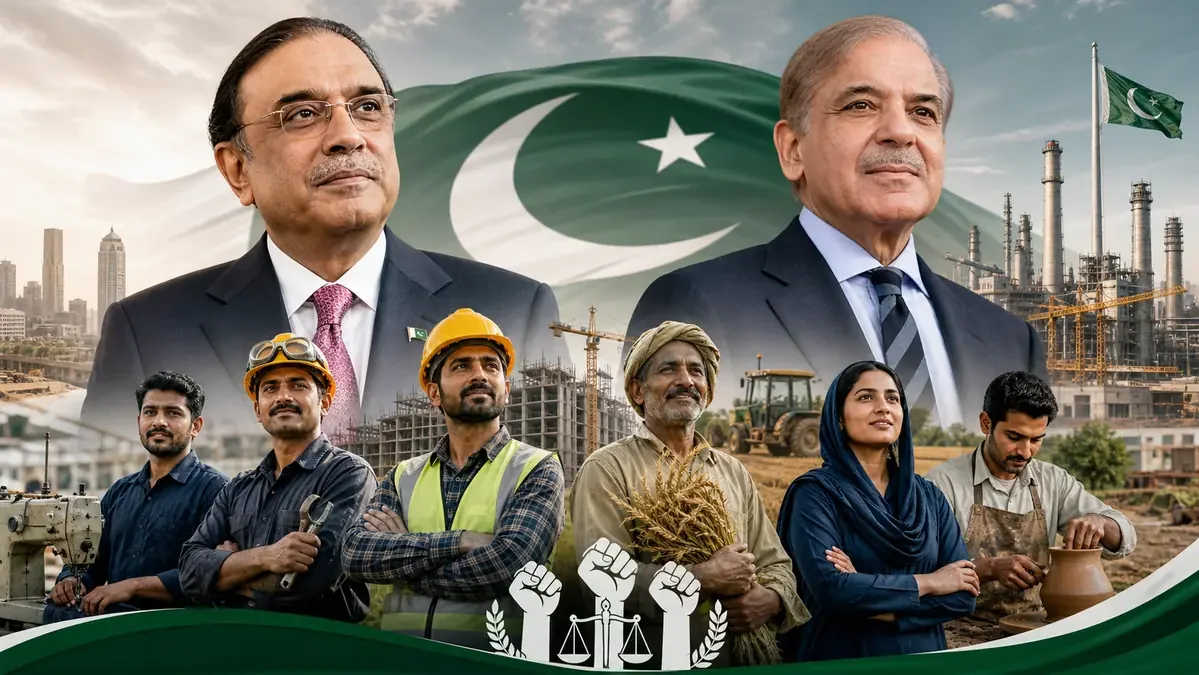

President Asif Ali Zardari and Prime Minister Shehbaz Sharif marked International Labour Day by paying tribute to workers and renewing their commitment to stronger labour protections, fair wages, and better working conditions across Pakistan.
Labour Day is observed every year on May 1 to honour the sacrifices and contributions of workers around the world. It highlights the long struggle for dignity, reasonable working hours, fair income, and protection from exploitation.
In his message, President Zardari recalled the historic Chicago labour movement, where workers demanded the principle of “eight hours for work, eight hours for rest, and eight hours for personal life.” He said this struggle laid the foundation for modern labour rights and remains a powerful reminder of human dignity.
The president also said that Pakistan’s 1973 Constitution protects citizens against exploitation and requires the state to promote fairness and social justice. He appreciated the role of workers in agriculture, industry, services, and other sectors, saying their dedication continues to support national progress.
President Zardari reaffirmed Pakistan’s commitment to international labour standards, including fair wages, social protection, equal opportunities, and the elimination of forced and child labour. He also praised overseas Pakistani workers, saying they contribute greatly to the economy through remittances and represent Pakistan with professionalism abroad.
Prime Minister Shehbaz Sharif also honoured labourers, farmers, artisans, factory workers, and professionals, calling them the backbone of society. He said their hard work keeps Pakistan’s economic and social system moving forward.
The prime minister highlighted the government’s focus on modern skills training, vocational education, language learning, and internationally recognised certifications. He said these steps would help Pakistani workers find better opportunities at home and abroad.
He also mentioned institutions such as the Employees’ Old-Age Benefits Institution and the Workers Welfare Fund, which provide pensions, housing, education, and other support services.
Both leaders urged governments, employers, trade unions, and industries to work together for a fairer economy where workers receive dignity, protection, and opportunity.