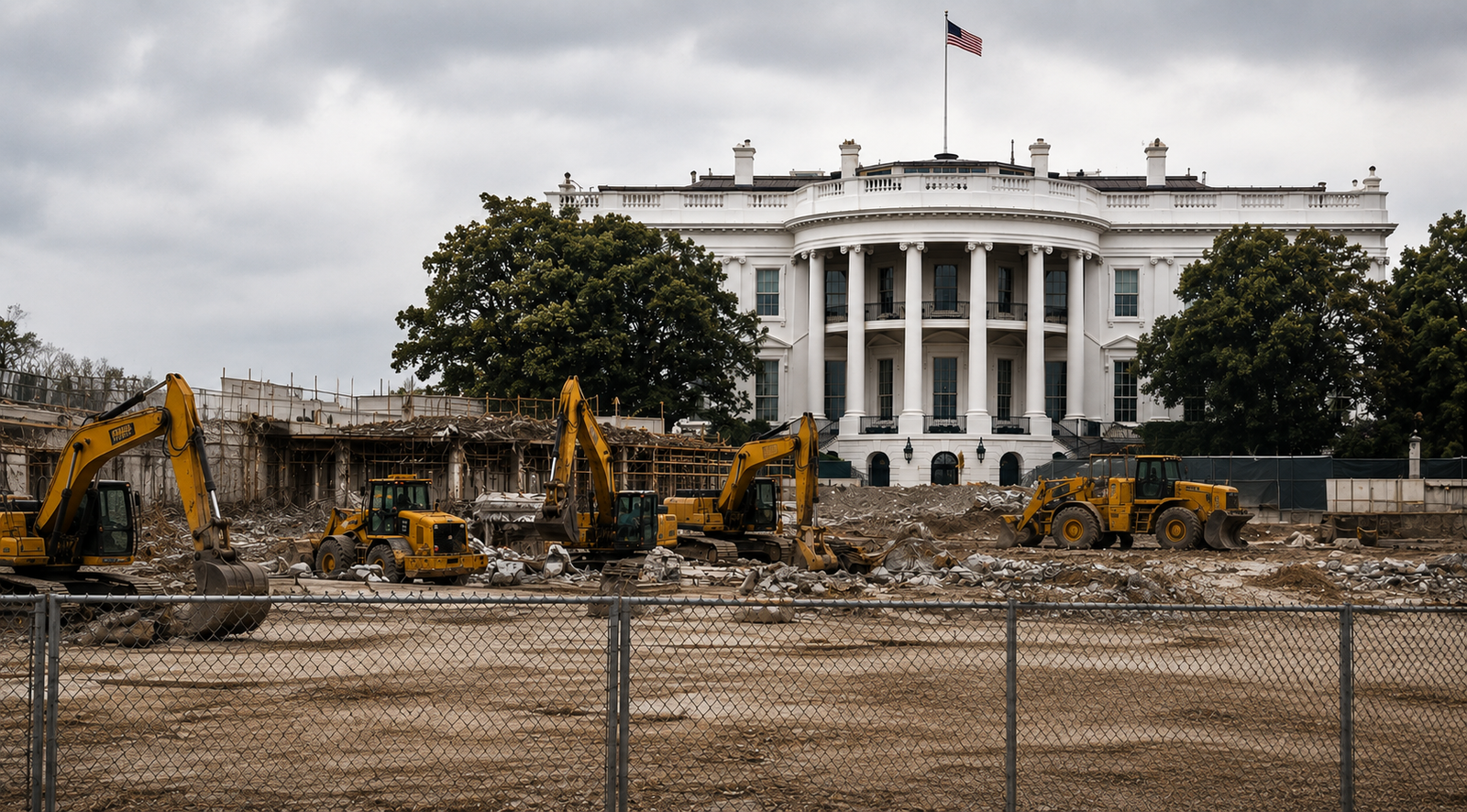

A US federal appeals court has ordered a halt to construction on President Donald Trump’s planned $400 million ballroom at the White House. The decision came on Friday from the Washington-based US Court of Appeals for the District of Columbia Circuit in a 2-1 ruling that deals a significant setback to the administration’s ambitious project.
The court upheld an earlier preliminary injunction secured by the National Trust for Historic Preservation. The group sued after the administration demolished the East Wing and began work on a massive 90,000-square-foot ballroom without first obtaining approval from Congress. In its opinion, the majority stressed that every president serves only as a temporary tenant of the White House, not its owner, and therefore cannot fundamentally alter the historic structure without legislative consent.
Judges Patricia Millett and Brad Garcia wrote that deciding whether such a large ballroom should be built is a matter for Congress, not something the executive branch can pursue on its own. They emphasized that national security claims do not give the administration a free pass to ignore the law or damage treasured national landmarks. The ruling stops above-ground construction while the lawsuit continues and until Congress grants approval. Underground work had previously been allowed to proceed under a district court order.
Circuit Judge Neomi Rao dissented, arguing that the lower court’s injunction represented judicial overreach and that construction should continue. The appeals court has stayed its own order for 14 days so the administration can seek review by the US Supreme Court.
President Trump strongly criticized the decision, calling it horrendous and politically motivated. On Truth Social he described the planned structure as a military center that includes bomb shelters, medical facilities, and protection against drones and missiles. He insisted the project is essential for security and promised to appeal. National Trust President Brent Leggs welcomed the ruling as a victory for the public’s right to have a say in protecting historic places like the White House.
The ballroom, whose cost has already doubled from earlier estimates, remains one of the most ambitious efforts by the administration to reshape government buildings in the capital.