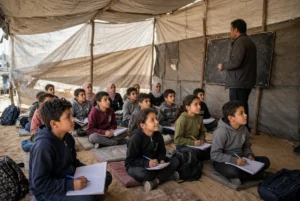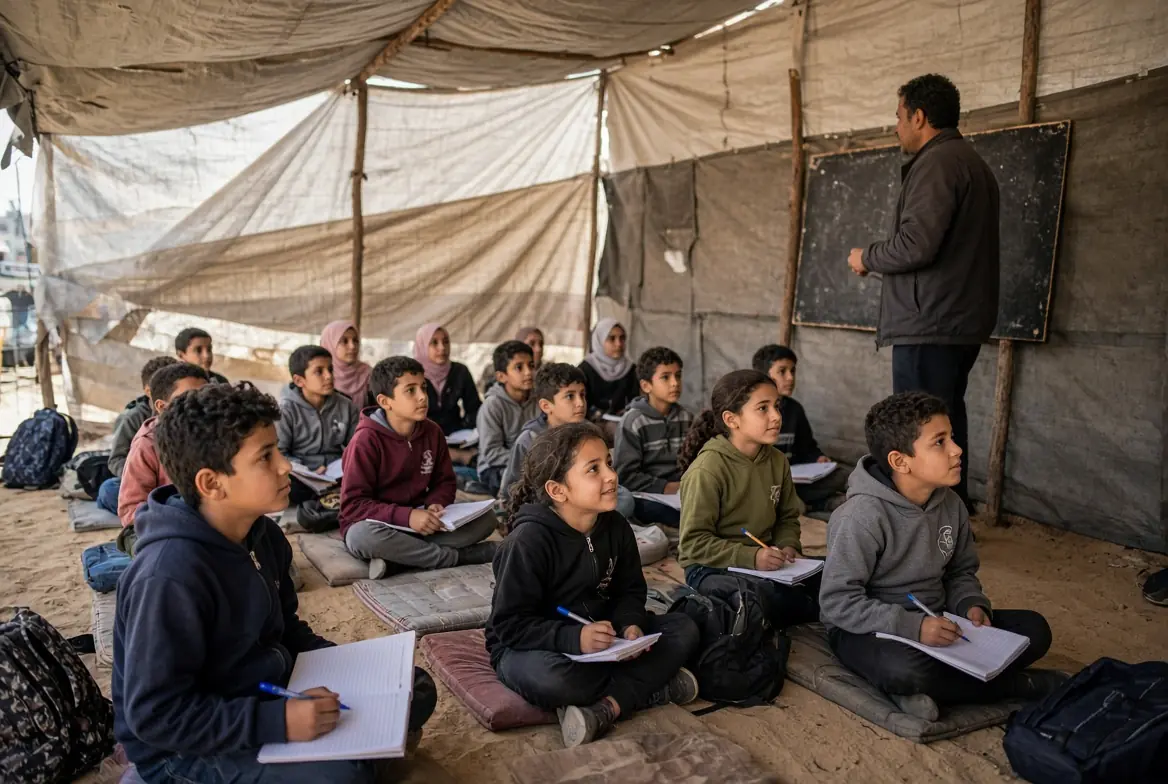

Hundreds of thousands of children in Gaza stepped back into classrooms on Saturday for the first time in nearly three years. Many arrived at damaged buildings or simple tents, often without uniforms, notebooks or pens that most families can no longer afford.
Unicef reports that 98 percent of schools across the enclave were destroyed or damaged during the conflict. Education officials estimate that around 660,000 students went without regular face-to-face lessons. The reopening stands as a fragile milestone after a war that killed roughly 22,000 students and more than 770 education workers, including 532 teachers, according to Ibrahim Ramadan, director of education for East Khan Younis.
Fifteen-year-old Samar Abu Salmi, who lives with her family in a tent, spoke with quiet hope. “We studied on phones, and we haven’t seen our teachers. Now we are back pursuing our dream, from one tent to another,” she said. Before the fighting, notebooks, pens and clothes were easy to buy. Today those everyday items remain out of reach for many.
Nearby, 14-year-old Moayed Abu Mustafa sat on the floor of a poorly ventilated tent. He has no proper shoes and lost friends in the war, yet refuses to quit. “Despite all of this, we will learn, even in a tent,” he declared. Another student, Yamen Abu Samra, admitted the fear that still follows every school day. “Now when we come to school we are afraid of stray bullets, rockets, strikes, everything. I’m sitting in a tent that has absolutely nothing, just the sun and the heat,” he said.
Despite the destruction, the Ministry of Education, supported by international and local partners, opened dozens of temporary learning centres made from tents, tarpaulins, sheet metal and wood. Some classrooms hold only mattresses and a blackboard. Others still shelter displaced families. Officials expect at least 540,000 students to attend in-person classes this year, while online lessons continue for those who cannot reach a centre or who left Gaza.
Stationery prices have climbed sharply because of import limits. A notebook that once cost three shekels now sells for fifteen, said trader Khaled Aliyan. Israeli forces still control more than 60 percent of the territory, and Palestinian authorities report that more than 73,000 people have died. Even so, the sound of children reading inside tents has returned, carrying a quiet promise of normal life after years of disruption.