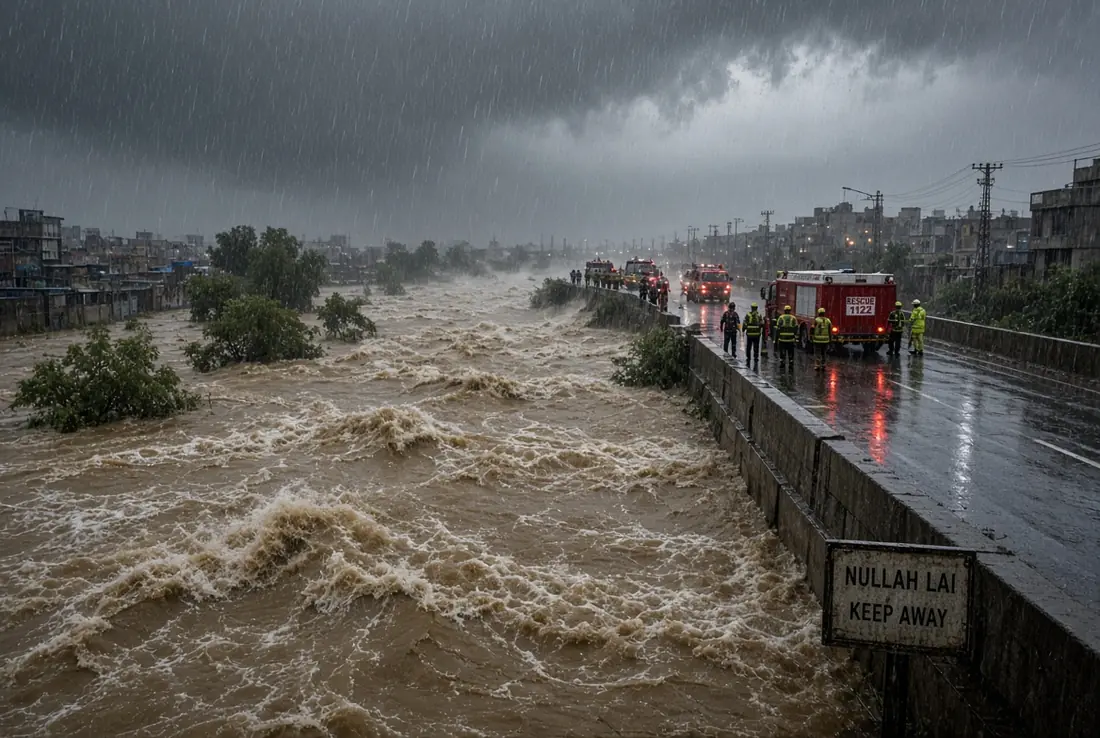

Torrential rain hit the twin cities of Rawalpindi and Islamabad early Tuesday, forcing authorities to shut down all government and private schools for the day. The downpour started around 3:20 am and continued until 8 am, according to the Pakistan Meteorological Department. Several areas saw dangerous water levels rise quickly, putting residents on high alert.
Rawalpindi Deputy Commissioner Captain (retd) Nadeem Nasir placed all relevant departments on high alert. He ordered people living near Nullah Lai to evacuate to safer places immediately. Rescue 1122 teams were already positioned around the drain, ready for any emergency. The Water and Sanitation Agency declared a rain emergency in the catchment areas of Nullah Lai and sent heavy machinery and teams to low-lying spots such as Liaquat Bagh, Committee Chowk underpass, Murree Road, Dhok Khaba, Circular Road and Sadiqabad.
Water levels climbed fast. At Katarian the flow reached 29 feet while the Gowalmandi bridge recorded 24 feet. Officials warned that a major flood surge was moving through Nullah Lai and more water could still enter Rawalpindi from Islamabad. Sirens were sounded as the flow increased and continuous monitoring of drains across the city continued.
The highest rainfall figures came from Shamsabad with 197 millimetres, New Katarian with 185 mm and Golra with 157 mm. Other areas also reported heavy totals: 152 mm in H-8, 98 mm at Saidpur Village, 86 mm in Pirwadhai and 72 mm each in I-12 and Chaklala. Several neighbourhoods including Safdarabad, Sadiqabad, Dhoke Khaba, Pirwadhai, Fauji Colony, Javed Colony and Arya Mohalla faced flooding.
DC Nasir confirmed that Rawalpindi recorded 200 millimetres of rain, the highest in three years. He said the biggest impact was on Nullah Lai because drains flowing into it were backing up and pushing water into nearby homes. Evacuation teams were already working in low-lying areas with support from the Pakistan Army, Rescue 1122 and Rangers. Only two emergency calls had been received so far, and officials hoped the situation would start improving soon once water levels in the drain began to fall.
Citizens were advised to avoid unnecessary travel while teams kept monitoring the affected zones.