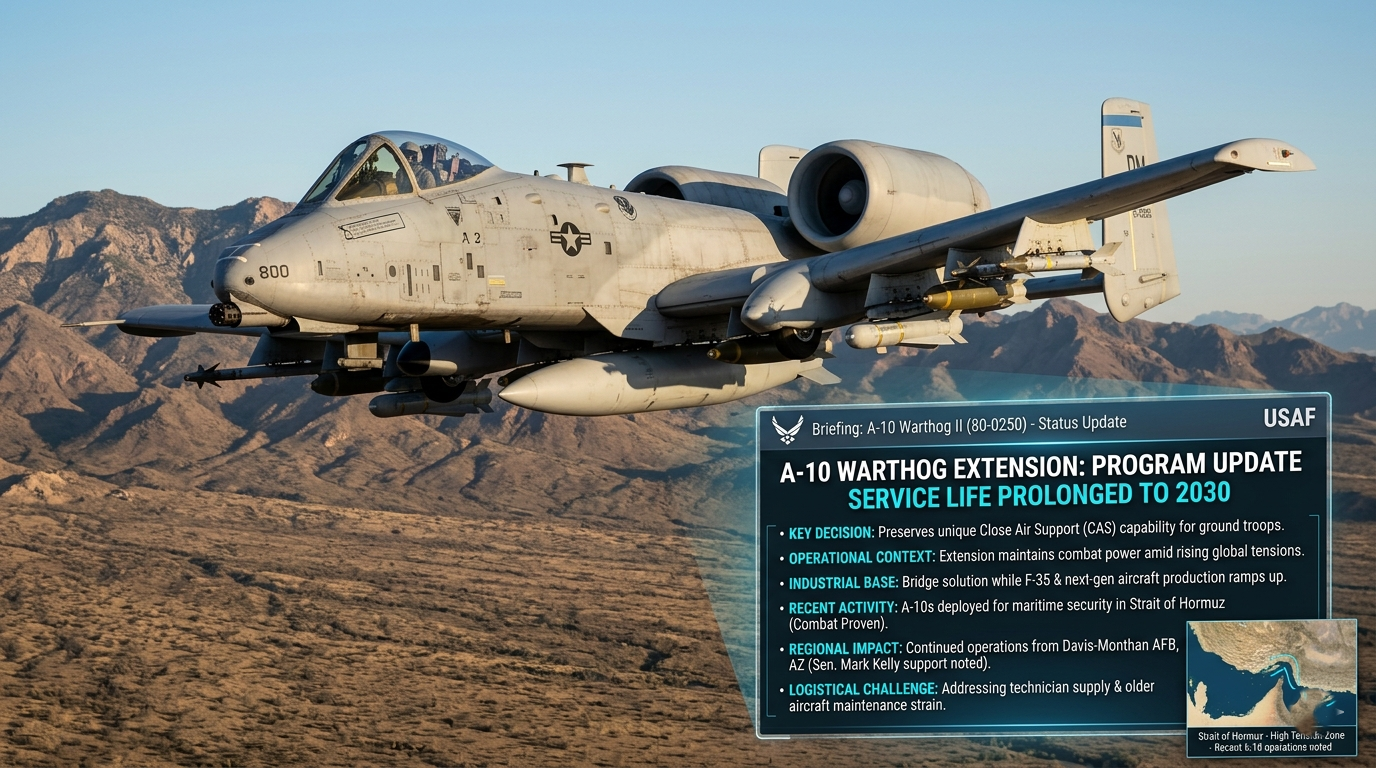

In a surprising turn for the legendary attack aircraft, the US Air Force has officially extended the service life of the A-10 Warthog until the year 2030. This decision comes despite recent reports of an aircraft loss near Iran during heightened tensions in the Strait of Hormuz. While Iranian authorities claimed the jet was shot down, US officials maintain the cause of the crash is still under investigation, emphasizing that the platform remains vital for combat power.
Air Force Secretary Troy Meink announced the extension, noting that preserving this specialized capability is essential while the defense industrial base scales up production of next-generation aircraft. The A-10, which first took flight in 1976, has faced retirement threats for decades. However, its recent deployment in the Middle East—where its massive nose-mounted guns were reportedly used against maritime targets—has reinforced its reputation for providing unmatched close air support.
The battle over the Warthog’s fate is as much political as it is military. A significant portion of the fleet is stationed at Davis-Monthan Air Force Base in Arizona, making it a cornerstone of the local economy. Arizona Senator Mark Kelly has been a vocal advocate for the platform, successfully blocking previous attempts by the Biden administration to retire the fleet. Kelly argues that the Air Force must not cut these planes without a suitable replacement capable of protecting ground troops.
Critics within the Pentagon warn that maintaining the aging Warthog fleet strains limited resources and diverts skilled mechanics away from newer platforms like the F-35. They argue the plane is too slow for modern contested environments. Nevertheless, the latest extension proves that the A-10’s combat capability and political staying power remain formidable. For now, the “tank killer” will continue its mission, bridging the gap toward a future era of hypersonic weapons and advanced aerial warfare.