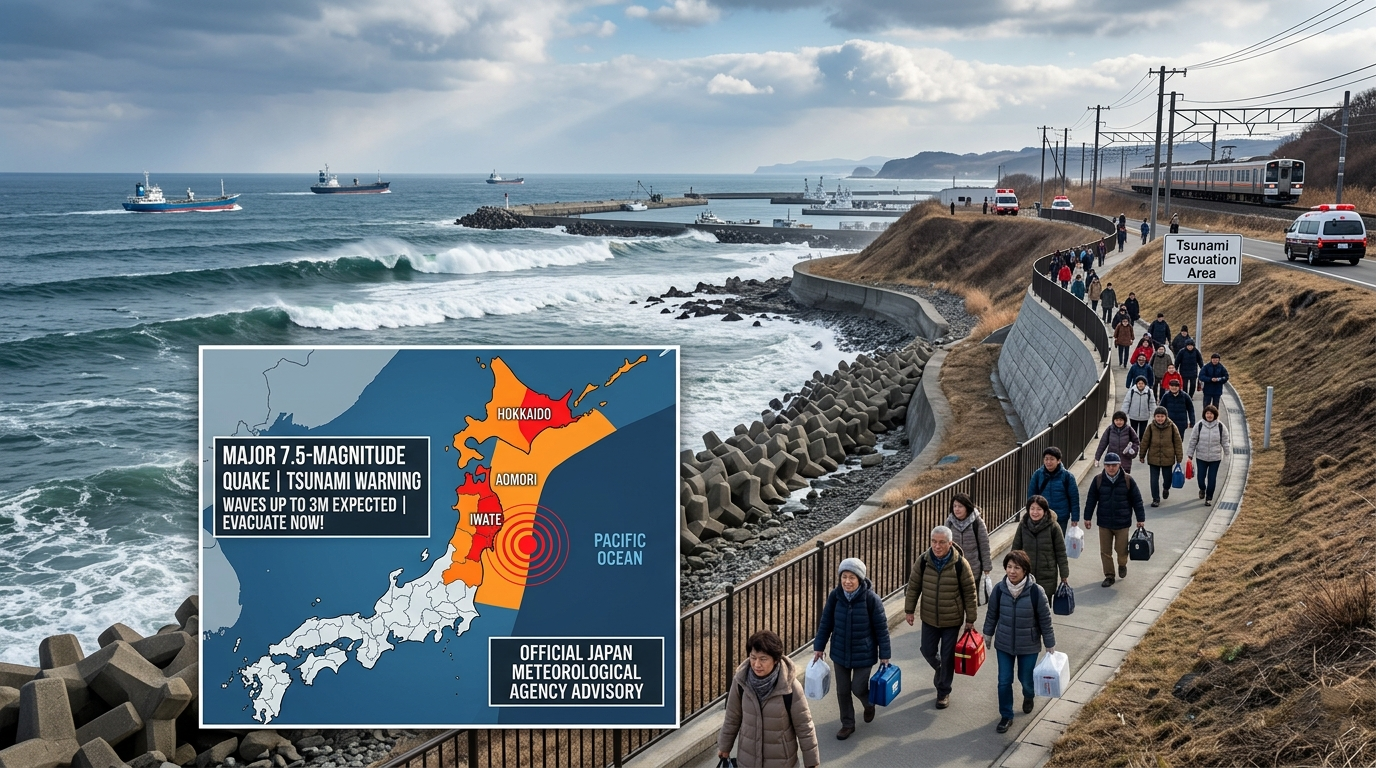

A powerful 7.5-magnitude earthquake struck off the northeastern coast of Japan on Monday, prompting immediate tsunami warnings and mass evacuations. The Japan Meteorological Agency (JMA) reported that the tremor’s epicentre was located in the Pacific Ocean at a shallow depth of 10km. Following the quake, authorities issued urgent alerts for waves reaching up to 3 metres (nearly 10 feet), specifically targeting the Iwate, Aomori, and Hokkaido prefectures.
Prime Minister Sanae Takaichi has officially established an emergency task force to manage the crisis. In a televised address, she urged citizens in coastal regions to prioritize their safety and evacuate to higher ground immediately. The impact was felt instantly across northern Japan, with the seismic intensity reaching an ‘upper 5’ on the local scale. This level of shaking is severe enough to cause unreinforced walls to collapse and makes it extremely difficult for individuals to remain standing or move safely.
The infrastructure in the affected regions has faced significant disruptions. Bullet train services in Aomori were halted as a precautionary measure, and local broadcasters showed dramatic footage of ships rushing out of Hachinohe port to avoid being battered by incoming waves. While no nuclear power plants are currently operational in the immediate vicinity, utility companies like Tohoku Electric are conducting rigorous checks at the Onagawa nuclear facility to ensure no damage was sustained during the tremors.
Japan’s location within the “Ring of Fire” makes it one of the most seismically active zones on Earth, accounting for roughly 20% of global earthquakes with a magnitude of 6.0 or higher. As the situation develops, officials continue to warn the public to stay away from the coastal areas, as the threat of secondary waves remains high. Emergency responders are on high alert, and “Azm-e-Istehkam” levels of resolve are being mirrored in the swift Japanese state response to protect its citizens from this natural disaster.