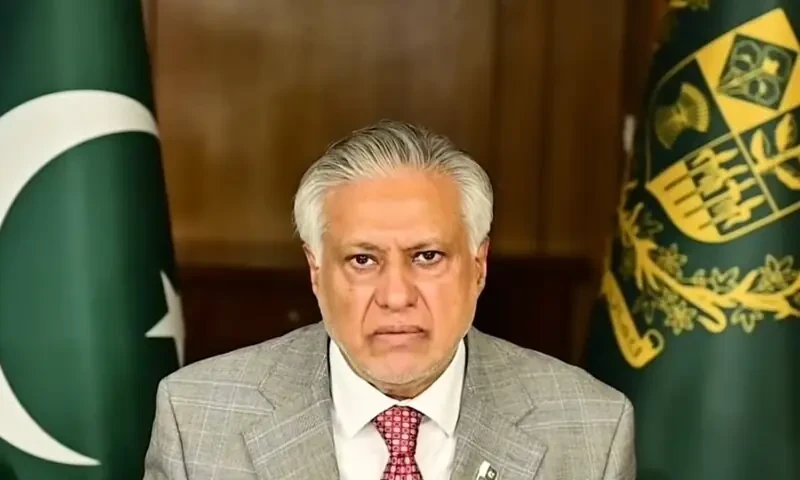

Deputy Prime Minister and Foreign Minister Ishaq Dar has voiced serious concerns over India’s expanding reservoir and water diversion projects on rivers linked to the Indus River System, warning that such developments could lead to what he described as “hydro hegemony” and threaten regional stability.
Speaking virtually at a conference on transboundary water resources in Brussels, Dar stated that Pakistan’s concerns are rooted not only in official statements from India but also in ongoing infrastructure projects being developed on key rivers, including the Indus, Chenab, and Ravi.
According to Dar, India has undertaken multiple initiatives involving reservoirs, expansion of existing water structures, and diversion schemes that could significantly affect the natural flow of rivers shared between the two countries. He noted that at least 17 projects are expected to reshape the river system and potentially provide India greater control over water resources flowing into Pakistan.
The deputy prime minister stressed that the Indus Waters Treaty (IWT), signed in 1960, remains a legally binding agreement that has survived several periods of conflict and tension. He emphasized that international agreements should be respected and upheld through established legal mechanisms rather than being disregarded.
Highlighting the importance of water security, Dar described rivers as vital resources that support economic activity, agriculture, culture, and human livelihoods. He warned that restricting access to water or using it as a political tool could have serious consequences for regional peace and cooperation.
“Water must never be viewed as an instrument of coercion,” Dar said, urging countries to pursue dialogue, diplomacy, and adherence to international law when addressing cross border water disputes.
He further noted that the challenges surrounding water governance are not limited to South Asia and should be viewed as a global issue requiring cooperation among nations. Reaffirming Pakistan’s commitment to peaceful conflict resolution, Dar said sustainable solutions can only be achieved through mutual respect, constructive engagement, and compliance with treaty obligations.
The deputy premier also highlighted Pakistan’s vulnerability to climate change, noting that despite contributing less than one percent of global greenhouse gas emissions, the country continues to face significant environmental and water related challenges.