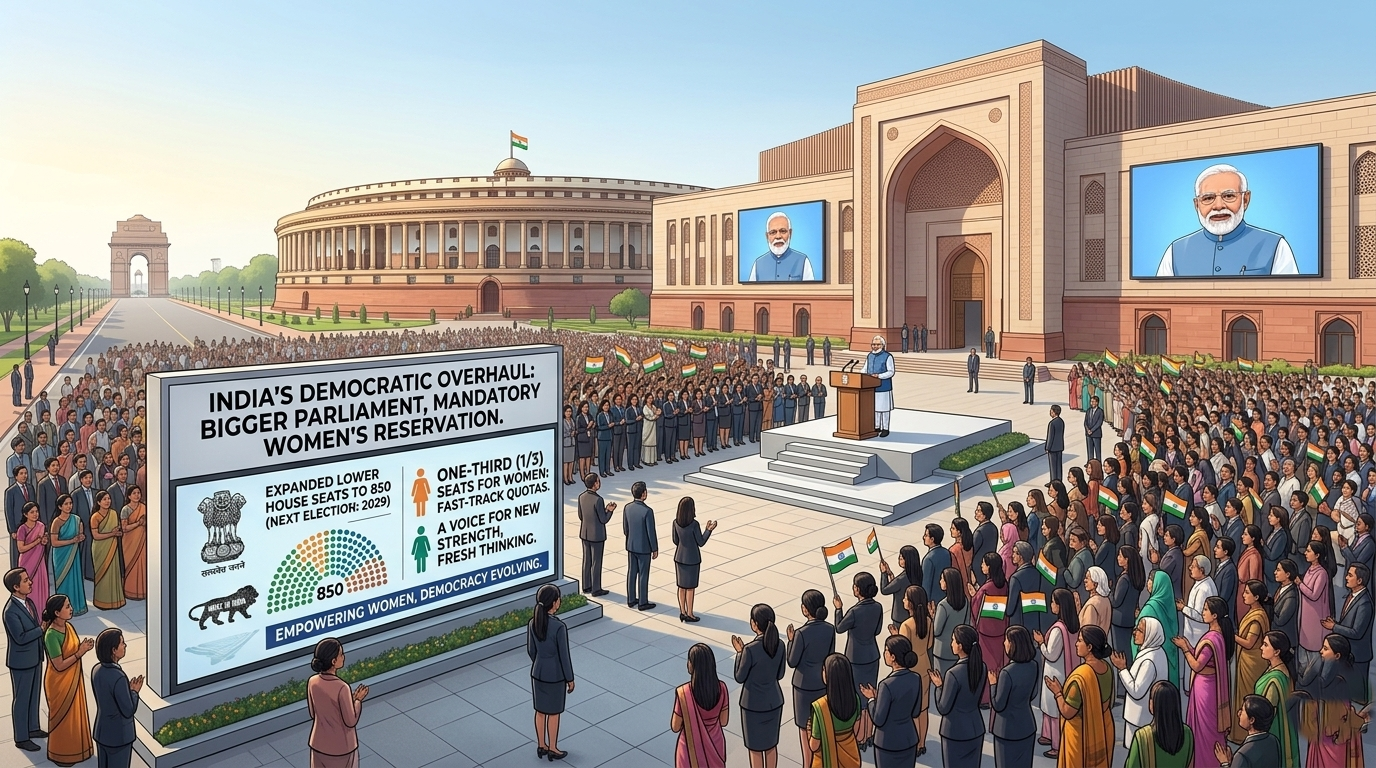

India has launched a groundbreaking initiative to overhaul its democratic structure, with Prime Minister Narendra Modi leading a push for a significantly larger parliament and a mandatory quota for women legislators. Addressing the lower house of parliament on Thursday, the Prime Minister framed the proposals as a crucial step to move India in a “new direction,” arguing that the enhanced women’s voice in the legislative process would introduce “new strength, fresh thinking, and a greater sense of sensitivity.”
The core of the proposed changes involves two main bills. First, the plan would increase parliament size by approximately 55%, expanding the number of seats in the lower house to around 850 by the 2029 general elections. State assemblies would see similar proportional increases. Secondly, the bills seek to fast-track women’s reservation, immediately implementing a plan to reserve one-third of the seats in these expanded legislative bodies for women. While a one-third share was agreed upon in 2023, the government’s new bills aim to apply these quotas by the next election cycle rather than waiting for a subsequent census. Currently, women hold only 14% and 17% of seats in the lower and upper houses, respectively.
However, the opposition is deeply critical of the timing and the potential manipulation of the system. While major opposition groups have stated they support women quotas in principle, they accuse the government of using these bills to politically manipulate the democratic system before the next election. Specifically, the Congress party has called for a simplified version of the women’s reservation that can come into effect immediately upon the law’s passage, rather than linking it to future boundary changes.
To pass, the bills require a two-thirds majority in both houses and must be ratified by at least half of the state legislatures. Since the ruling coalition does not currently hold a two-thirds majority, the success of this monumental effort hinges on gaining support from smaller parties and convincing some of the skeptical opposition groups to back the proposals. Parliament is expected to vote on the changes this week.
According to officials, the Airbus helicopter, operated by local company Matthew Air Nusantara, lost contact with air traffic control just five minutes into the flight on Thursday morning. This sudden loss of communication raised immediate alarm, prompting a search and rescue operation.
Authorities later confirmed that all eight individuals on board, including two crew members and six passengers, had died in the crash. Among the victims was one Malaysian national, making the incident an international tragedy as well.
Search and rescue teams worked under challenging conditions to locate the crash site. The helicopter was eventually found in a steep and heavily forested area, making recovery efforts difficult. By Thursday evening, rescuers had reached the site and recovered the bodies. The victims were then transported to the provincial capital, Pontianak, for further procedures.
Indonesia, known for its vast geography and thousands of islands, heavily depends on air transportation to connect remote regions. However, the country has faced repeated challenges related to aviation safety, with several fatal accidents reported in recent years.
Earlier incidents include a plane crash in Sulawesi that killed ten people and another helicopter crash in South Kalimantan that resulted in multiple fatalities. These recurring accidents continue to raise concerns about flight safety standards, maintenance practices, and operational risks in difficult terrains.
This latest disaster serves as a reminder of the risks associated with air travel in remote regions. Authorities are expected to conduct a detailed investigation to determine the exact cause of the crash and to prevent similar tragedies in the future.