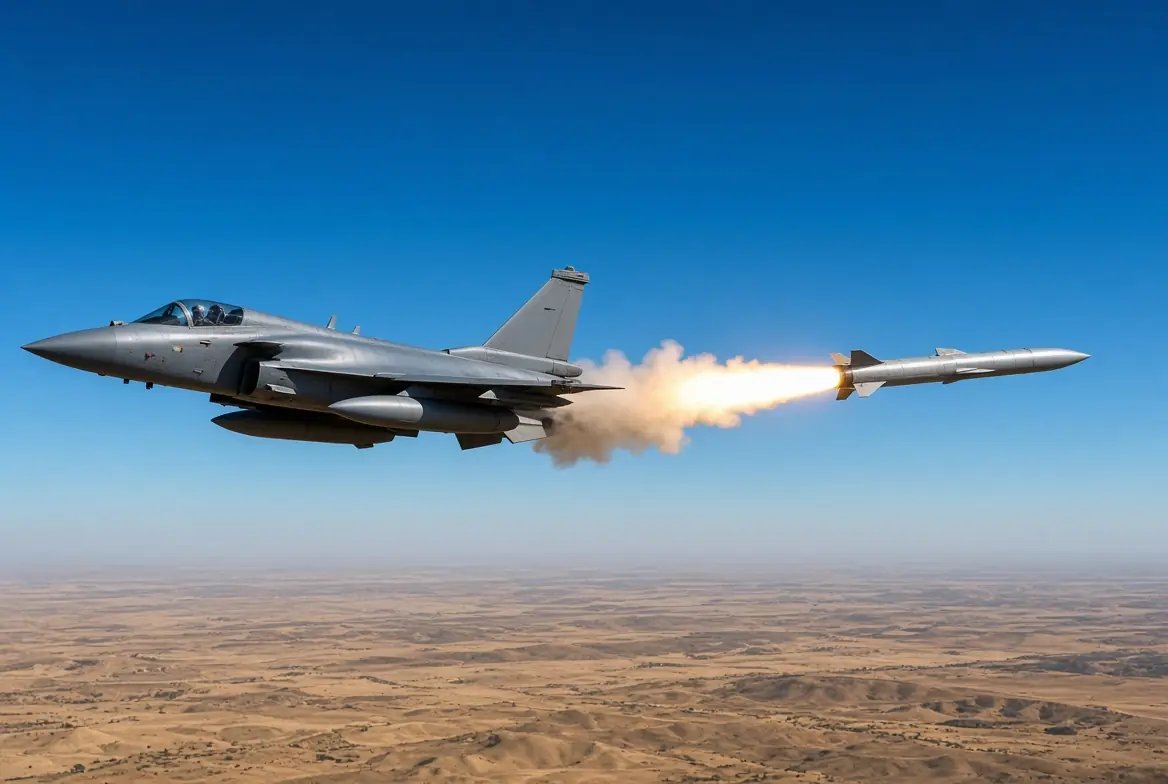

Pakistan has achieved a major milestone in its defence sector by successfully conducting the flight test of its first indigenously developed Faaz air-to-air missile. The Inter-Services Public Relations (ISPR) confirmed the successful trial on Tuesday, highlighting it as a clear sign of progress in the country’s aerospace and military technology.
The Faaz missile comes fitted with a modern terminal guidance system. This advanced feature allows it to lock onto and engage enemy aircraft at much longer distances than earlier systems. Military officials stated that the weapon will give the Pakistan Air Force greater operational flexibility during aerial combat and strengthen the overall national defence posture.
Senior officers from the Pakistan Armed Forces, along with the scientists and engineers who worked on the project, were present at the test site to witness the launch. The successful flight demonstrated the growing technical maturity, innovation, and self-reliance of Pakistan’s defence industry. President Asif Ali Zardari, Prime Minister Shehbaz Sharif, Chief of Army Staff and Chief of Defence Forces Field Marshal Syed Asim Munir, and other services chiefs congratulated the teams involved for their hard work and achievement.
This development comes shortly after another important test. On 13 October 2026, the Pakistan Army successfully launched the extended-range version of the Fatah-2 hypersonic ballistic missile. The Fatah-2 ER is equipped with advanced navigation systems and modern avionics. It can strike targets with high precision and has the ability to evade enemy missile defence systems because of its unique trajectory and strong manoeuvrability features. The extended range of this system further boosts the Army’s capacity to hit deep targets when needed.
Together, the Faaz air-to-air missile and the Fatah-2 ER show that Pakistan continues to invest in modern, home-grown weapon systems. These tests reflect steady progress toward reducing dependence on foreign technology while enhancing the country’s ability to protect its airspace and respond to potential threats. The focus remains on building reliable, effective systems through the dedicated efforts of local scientists and engineers.
The successful trials have been welcomed as positive steps that improve both conventional and strategic defence capabilities. Pakistan’s defence industry is steadily moving forward with practical, tested solutions designed to meet current and future security needs.