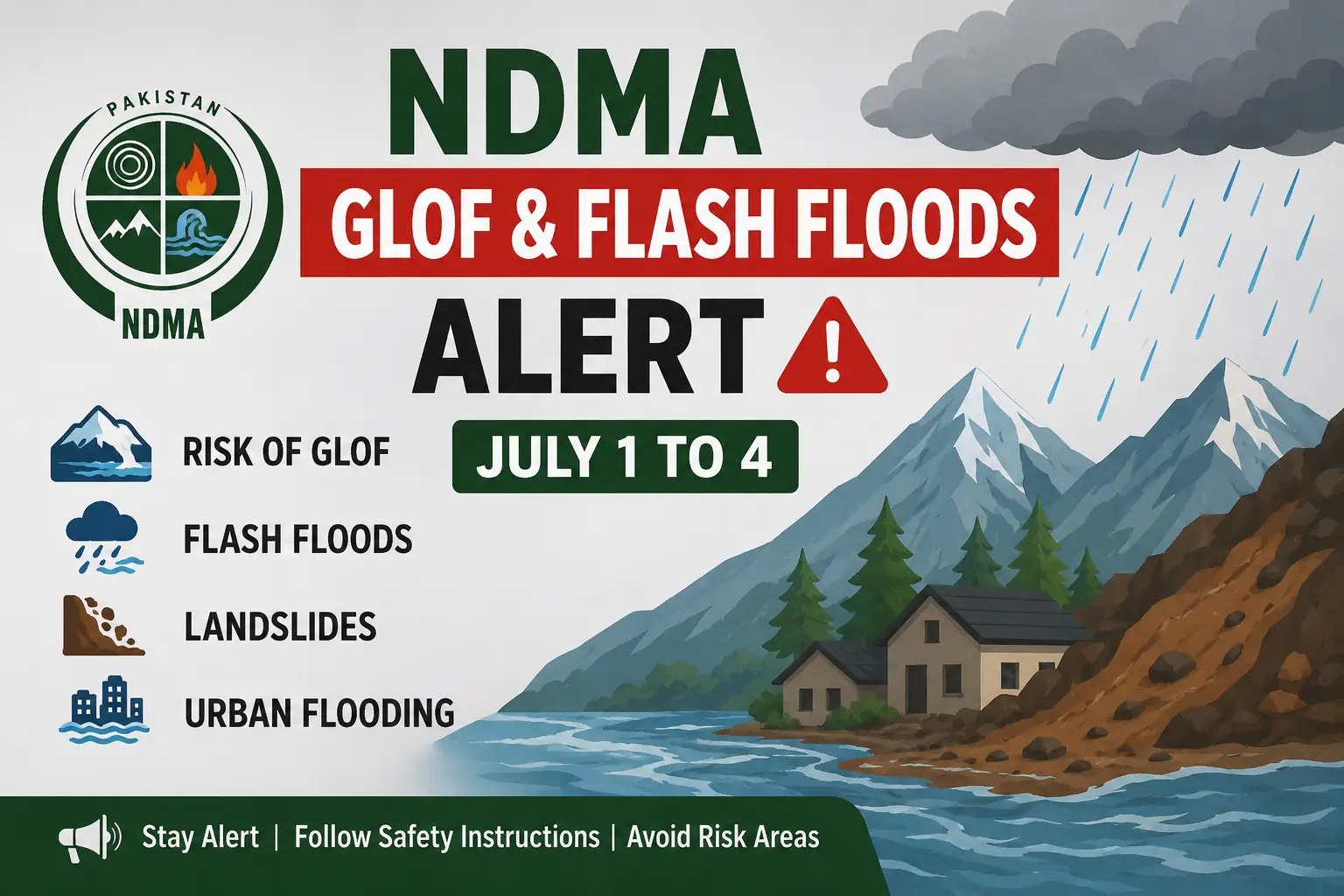

Pakistan’s National Disaster Management Authority (NDMA) has issued a nationwide warning about the increasing risk of glacial lake outburst floods (GLOFs), flash floods, landslides, and urban flooding as an active monsoon system continues to affect several parts of the country. The advisory remains in effect from July 1 to July 4, urging authorities and residents to stay alert.
According to the National Emergencies Operation Centre (NEOC), a combination of heavy monsoon rainfall, westerly weather systems, and rising temperatures is expected to speed up glacier melting in northern regions. This could significantly increase the likelihood of dangerous flood events, particularly in glacier fed valleys and mountainous communities.
The NDMA stated that vulnerable areas in Gilgit Baltistan, Khyber Pakhtunkhwa (KP), and Azad Jammu and Kashmir (AJK) face a higher threat of GLOFs, which may trigger sudden flash floods, rockfalls, landslides, and debris flows. Residents living in Hunza, Nagar, Ghizer, Skardu, Shigar, Ghanche, Kharmang, Astore, Diamer, Upper and Lower Chitral, and Swat have been advised to remain cautious and closely follow official safety instructions.
Authorities also warned that increasing water flow in the Hispar Hopper Nullah may lead to riverbank erosion and localized flooding in surrounding communities.
In a separate advisory, the NEOC forecast flash floods in several districts across KP, Punjab, Balochistan, AJK, and Gilgit Baltistan. Seasonal streams and hill torrents in districts including Peshawar, Mardan, Swabi, Kohat, Bannu, Rawalpindi, Attock, Lahore, Faisalabad, Sialkot, Zhob, Sibi, and Dera Bugti could experience a rapid rise in water levels during the forecast period.
The NDMA also cautioned that urban flooding may affect low lying areas in major cities, causing road closures, traffic disruptions, and damage to public infrastructure such as bridges and irrigation systems. Relevant departments have been instructed to strengthen emergency response measures, improve drainage systems, and continuously monitor river flows and glacial lakes.
Residents, particularly those living near rivers, streams, and low lying areas, are advised to avoid unnecessary travel, remain vigilant, and follow all official weather advisories until conditions improve.