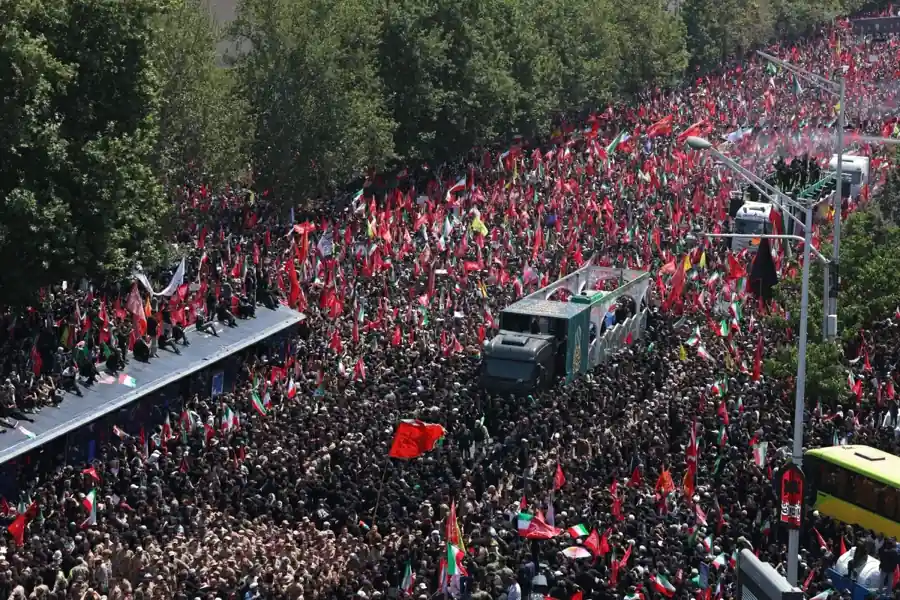

Millions of mourners filled the streets of Tehran on Monday as Iran held a massive funeral procession for its late Supreme Leader Ali Khamenei. The ceremony marked one of the country’s largest public gatherings in decades, with officials suggesting attendance could rival the historic funeral of Ayatollah Ruhollah Khomeini in 1989. The procession comes after weeks of regional conflict and serves as a major display of national unity.
After lying in state for two days at Tehran’s Grand Mosalla, Khamenei’s coffin was carried through the capital on a specially prepared vehicle covered with flowers. Thousands lined the streets, waving Iranian flags, carrying portraits of the late leader, and chanting slogans as the funeral procession slowly moved through the city.
Authorities implemented strict security measures to prevent overcrowding and avoid a repeat of the deadly stampede that occurred during Khomeini’s funeral nearly four decades ago. Concrete barriers separated the public from the funeral route, while emergency teams remained on standby. Water trucks were also deployed to help mourners cope with the intense summer heat.
The funeral attracted several senior Iranian officials, including Parliament Speaker Mohammad Bagher Ghalibaf, former President Mahmoud Ahmadinejad, Revolutionary Guards commander Ahmad Vahidi, and Quds Force chief Esmail Qaani. Three of Khamenei’s sons also appeared publicly, although his successor, Mojtaba Khamenei, remained absent from the ceremony. Officials have previously stated that he was injured during the airstrikes that killed his father, but no further details have been released.
Following the Tehran procession, additional funeral ceremonies are scheduled in Qom, Najaf, and Karbala, before Khamenei is laid to rest in his hometown of Mashhad later this week.
Many mourners described the funeral as both a tribute to Iran’s longtime leader and a demonstration of national resilience following recent military tensions. Some participants also called for justice over Khamenei’s assassination, while officials emphasized unity and support for the country’s leadership during a period of heightened regional uncertainty.