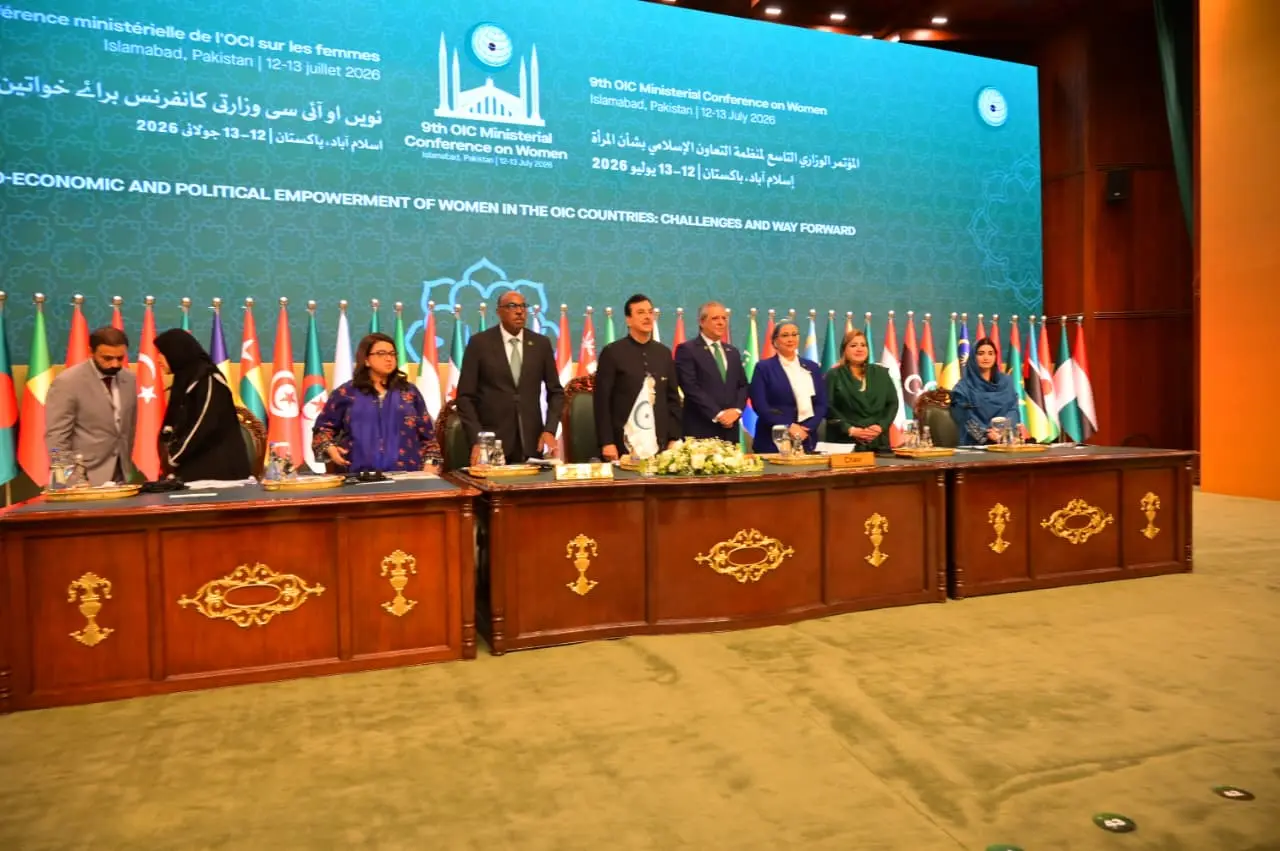

The Organisation of Islamic Cooperation (OIC) has officially adopted the Islamabad Declaration during the Ninth Ministerial Conference on Women held in Islamabad, reaffirming its commitment to promoting the social, economic, and political empowerment of women and girls across the Muslim world. The conference also introduced the Islamabad Initiative on Women’s Digital Inclusion, a landmark platform designed to improve digital opportunities for women in OIC member states.
The declaration encourages member countries to strengthen laws, policies, and institutional frameworks that enable women to participate fully in politics, leadership, public service, and economic development. It also calls for the removal of barriers limiting women’s access to quality education, vocational training, employment, entrepreneurship, and financial services.
A major highlight of the conference was the launch of the Islamabad Initiative on Women’s Digital Inclusion, which aims to expand digital literacy, STEM education, artificial intelligence skills, cybersecurity awareness, and digital entrepreneurship among women and girls. The initiative also seeks to improve access to affordable internet, digital devices, and modern technologies, particularly for women living in rural and underserved communities.
The declaration further urged OIC member states to promote inclusive financial systems, including Islamic finance, microfinance, and digital financial services, while supporting women-led small and medium-sized businesses through easier access to capital, innovation, and international trade opportunities.
Delegates also emphasized the need for stronger action against violence targeting women, including cyber harassment, online abuse, exploitation, and technology facilitated violence. The declaration called for enhanced cooperation to combat Islamophobia, discrimination, xenophobia, and hate speech directed at Muslim women worldwide.
The conference reaffirmed solidarity with the women and girls of Palestine and Indian Illegally Occupied Jammu and Kashmir (IIOJK), urging the international community to provide humanitarian, educational, legal, and psychosocial assistance.
Concluding the event, OIC Assistant Secretary General Dr. Tarig Ali Bakheet praised the consensus reached by member states and described the adopted resolutions as a roadmap for strengthening cooperation and delivering measurable progress in women’s empowerment. Pakistan was also commended for successfully hosting the conference and assuming the chairmanship of the Ministerial Conference on Women.