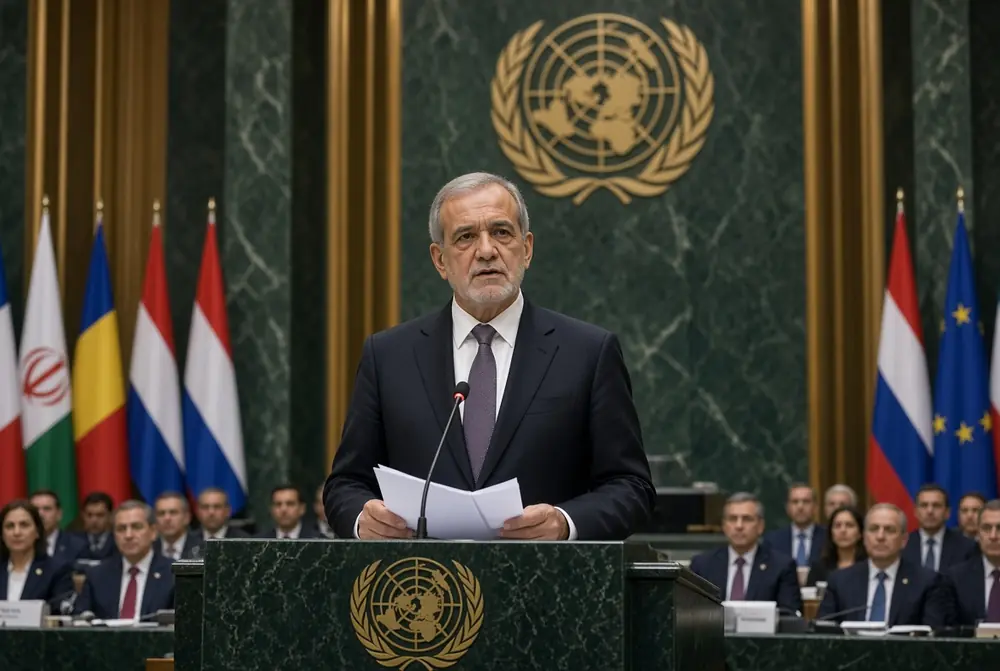

Iranian President Masoud Pezeshkian delivered a strong wartime address at the United Nations General Assembly on Wednesday and accused US President Donald Trump of showing a bullying mentality. He made clear that Iran would not surrender in the ongoing conflict but remained open to diplomacy if talks were held on equal terms.
Speaking before the 193-member assembly, Pezeshkian rejected Trump’s recent warning that the United States could annihilate Iran if no deal were reached. “The remarks made by the US president yesterday are a sign of a bullying mentality,” he said. “The Iranian people will not bow to pressure.” He also pushed back against Trump’s description of Iran as the world’s leading sponsor of terrorism, stating that those who train terrorists should not label others in the same way.
The United States delegation walked out of the hall at the start of Pezeshkian’s speech. The Iranian leader opened by holding up photographs of civilian victims, including schoolgirls, and accused American forces of killing non-combatants. He specifically referred to a missile strike on a primary school in Minab that Iranian officials say killed more than 175 children and teachers in the early days of the conflict.
Pezeshkian stressed that Iran has no intention of seeking nuclear weapons yet will never abandon its right to a peaceful nuclear program. “Neither nuclear weapons nor giving up nuclear knowledge,” he declared. He repeated several times that Tehran is ready to resolve tensions through negotiations but will not accept the language of force or threats.
Seven months into the conflict, the United States has shifted toward heavier economic pressure after military action failed to force Iran to yield. Iranian leaders worry that rising prices and weaker trade could spark fresh domestic unrest. The Strait of Hormuz, which carries a large share of global oil and gas, remains a flashpoint. Pezeshkian said Iran has conveyed conditions for reopening the waterway and insisted it cannot be that others benefit while Iran is denied access.
Despite the sharp tone, the Iranian president left the door open for talks. He warned that permanent deployment of hostile fleets and further expansion of the war will not bring peace. The speech underscored Iran’s dual message of defiance and readiness for diplomacy as the conflict continues to strain regional stability and global energy markets.