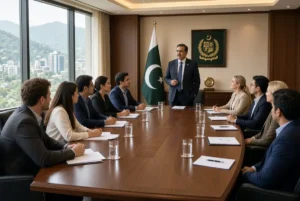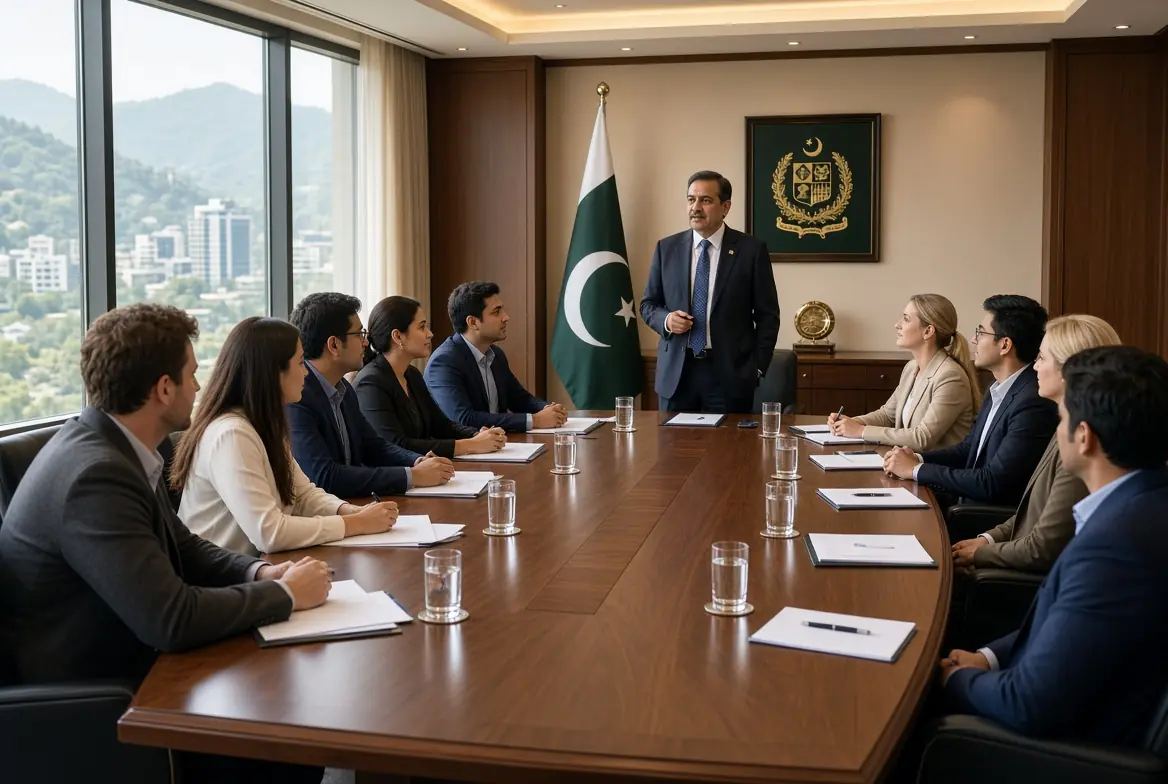

Planning Minister Ahsan Iqbal has stressed that Pakistan needs to move beyond temporary economic stabilisation and focus on long-term transformation. Speaking to a group of Harvard Business School MBA students in Islamabad, he said the country should not be judged only by its current challenges but by the scale of its hidden potential.
With a population of nearly 260 million, a large youth population, a strategic location, rich agricultural and mineral resources, a growing digital economy and a strong global diaspora, Pakistan has strong foundations for lasting progress. The minister made it clear that the real task is to turn macroeconomic stability into sustained growth, higher productivity, more exports, greater investment and better employment opportunities.
Iqbal explained that Pakistan must break the repeated cycle of short booms followed by external pressure, stabilisation and then slowdown. He said the economy needs to be rebuilt around productivity and exports. “Stabilisation is necessary, but stabilisation alone is not development. Pakistan cannot austerity its way to prosperity. We have to earn our prosperity through productivity, innovation, investment and exports,” he told the students.
He briefed the visitors on URAAN Pakistan, the government’s national transformation plan built on the 5Es. These cover exports, enterprise and employment; e-Pakistan and the digital economy; environment, climate, food and water security; energy and infrastructure; and equity, ethics and empowerment.
Pakistan has set a goal of becoming a one trillion dollar economy by 2035. However, Iqbal stressed that the target is not just about a bigger GDP number. The real question is what the country will be able to produce and sell competitively in 2035 that it cannot produce today. Development, he said, is about building national capabilities.
The minister identified productivity, quality and innovation as the key factors that will decide Pakistan’s future competitiveness. The government is working to create a national culture of Productivity, Quality and Innovation so that “Made in Pakistan” becomes linked worldwide with reliability and value.
He also highlighted the importance of human capital. A young population can become a strength only if it receives proper education, nutrition, healthcare, skills and jobs. Human capital, he said, is Pakistan’s most important infrastructure. Artificial intelligence offers a historic chance for developing countries, but nations that fail to build technological skills risk falling behind. Pakistan must become a producer and adapter of technologies in areas such as AI, biotechnology, advanced manufacturing, agriculture and space sciences.
On climate change, Iqbal noted that resilience is no longer a separate environmental issue. It directly affects fiscal stability, food security, infrastructure, public health and poverty. He also pointed to the next phase of the China-Pakistan Economic Corridor, which should focus more on industrial cooperation, technology transfer, agriculture, exports and business partnerships.
Finally, he underlined the need for policy continuity. Successful nations share one common trait: they stick to a clear direction over time. Economic development, he concluded, is the compound interest of good policies applied consistently.