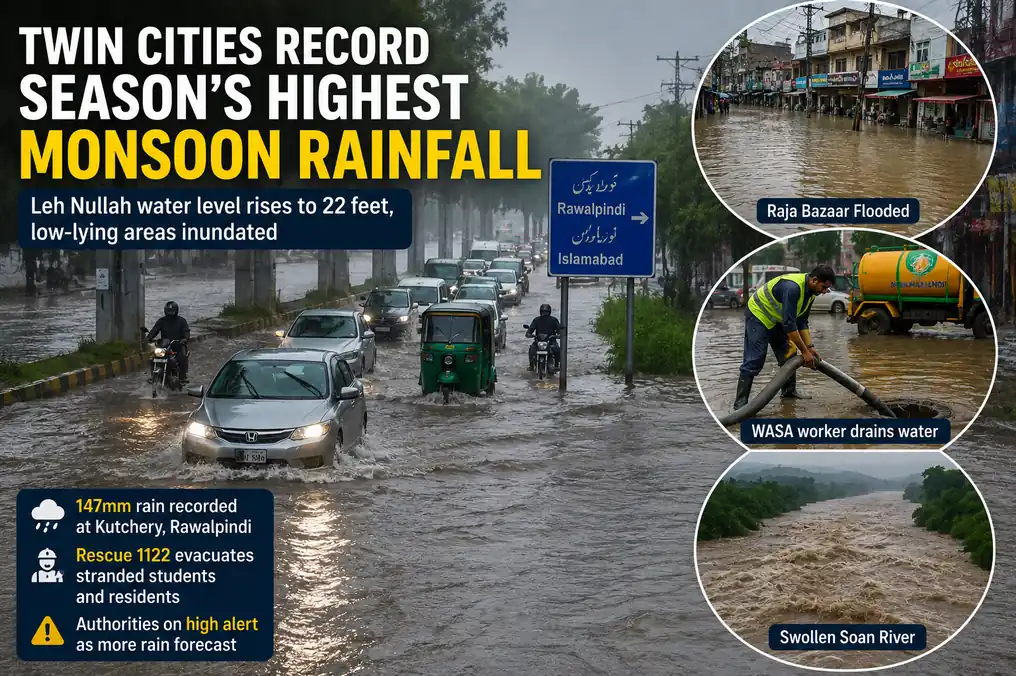

Rawalpindi and Islamabad received the highest monsoon rainfall of the season on Wednesday, causing widespread flooding in low lying areas and disrupting daily life across the twin cities.
Continuous heavy rain pushed the water level in Leh Nullah to 22 feet at New Kattarian Bridge, while several residential and commercial areas were inundated. Rainwater entered houses, shops and markets, with some locations recording water depths of up to three feet. Vehicles were also submerged as water accumulated on roads and major intersections.
Residents faced a difficult day as they worked to remove water from their homes. Some families moved to rooftops after floodwater entered their houses. The newly developed pedestrian street in Raja Bazaar was also flooded, while parts of Fauji Colony, Westridge and other areas suffered water damage. A cemetery wall collapsed in the cantonment area, affecting several graves, while some boundary walls also fell.
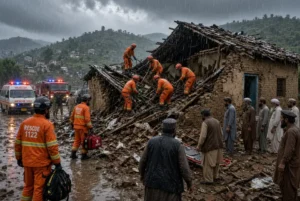
Rescue 1122 teams responded to several emergencies. Around 400 students at a madrassa near Saigal Street became stranded after water entered the lower floor. Rescue officials safely evacuated the students. In Gulrez Housing Scheme-I, nine people, including three children, were also rescued from a flooded house. No deaths were reported in either incident.
The Pakistan Meteorological Department recorded 147 millimetres of rain at Kutchery, the highest reported figure in Rawalpindi. Shamsabad received 127mm, Pirwadhai 123mm, and Chaklala and New Kattarian each recorded 121mm. Islamabad also received substantial rainfall at several locations.
Officials said the situation remained under control because Leh Nullah did not overflow and its water level receded after the rain stopped. However, authorities remained on alert as further showers were forecast.
The Met Office warned that additional heavy rain could trigger urban flooding in low lying parts of Islamabad and Rawalpindi, while flash floods and landslides were possible in vulnerable areas of Punjab, Khyber Pakhtunkhwa, Kashmir and northern regions.
Civil Defence and Rescue 1122 teams remained prepared to respond to emergencies as the monsoon system continued affecting the upper parts of the country.