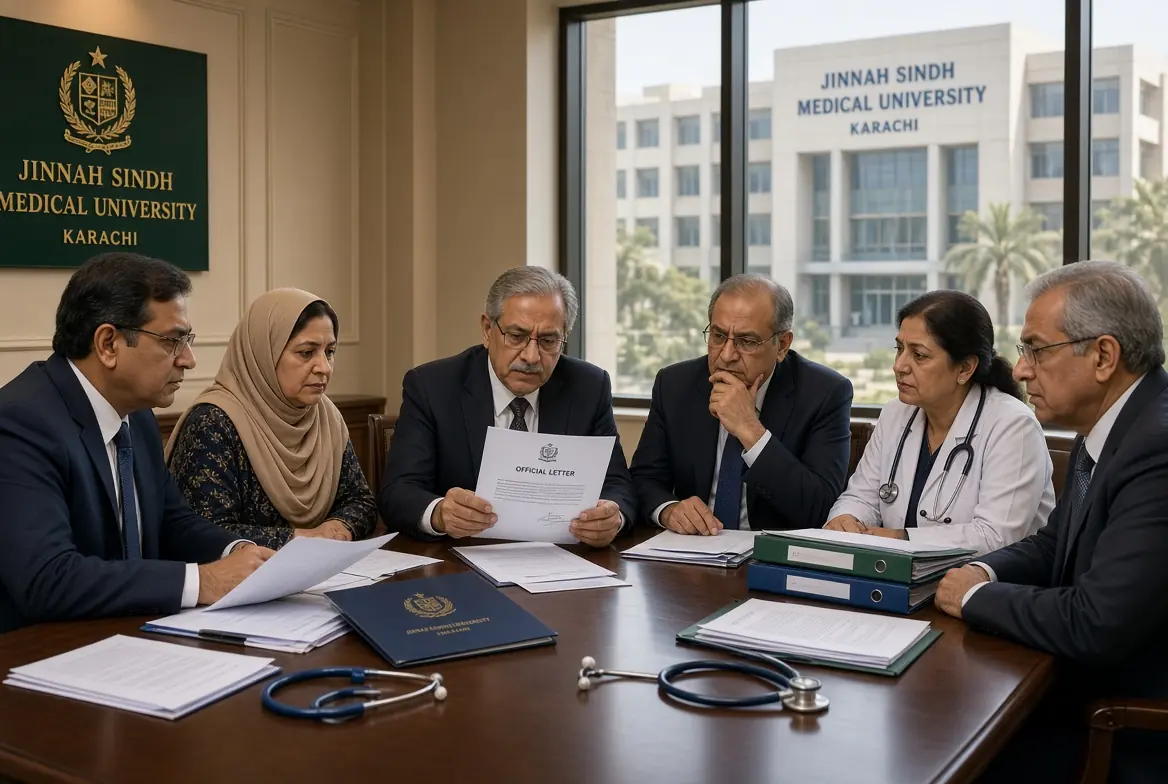

Six faculty members of Jinnah Sindh Medical University have written to the vice chancellor asking him to review the provincial cabinet’s decision to grant a three year extension to a retiring professor. The staff members believe the move goes against the principles of merit, seniority and prescribed promotion criteria.
In a letter dated August 11, Associate Professors Dr Shazia Naseeb and Dr Memoona Rehman, along with Assistant Professors Dr Shafaq Ismail, Dr Omema Akhtar, Dr Mahrukh Hyder and Senior Registrar Dr Saira Sheikh from the department of obstetrics and gynaecology at JPMC, raised serious concerns. They referred to an August 10 letter from the Universities and Boards Department and pointed out that many associate and assistant professors are waiting for promotion based on seniority and eligibility rules.
The faculty members argued that such extensions are normally given only when no suitable candidate is available. If the decision to reappoint Prof Dr Nighat Shah is implemented, it could harm the career progression of eligible colleagues and lower the morale of the teaching staff. They also warned that it might create administrative problems and affect the quality of teaching, research and patient care.
Prof Nighat Shah, who heads an obstetrics and gynaecology ward at JPMC, received the three year extension a few days before her retirement. She is the daughter of former chief minister Qaim Ali Shah. Sources said the department had already advertised teaching posts, which led to discussion on social media.
Government officials say the extension is contractual and allowed under PMDC rules that permit public sector institutions to engage retired faculty up to the age of 65. A May 19 notification of the PMDC clearly states that such contracts should not affect the promotion chances of junior faculty.
JPMC Deputy Executive Director Dr Yahya Tunio strongly defended the decision. He said Dr Nighat Shah is highly qualified and had revived a gynaecology unit that had remained idle for more than a decade. Under her leadership the department started new services in menopause care, adolescent health and early pregnancy assessment. She also secured research grants and played a key role in maternal health initiatives.
The six faculty members have requested the vice chancellor to carefully examine the matter in the larger public interest and ensure that seniority and established criteria are fully respected.