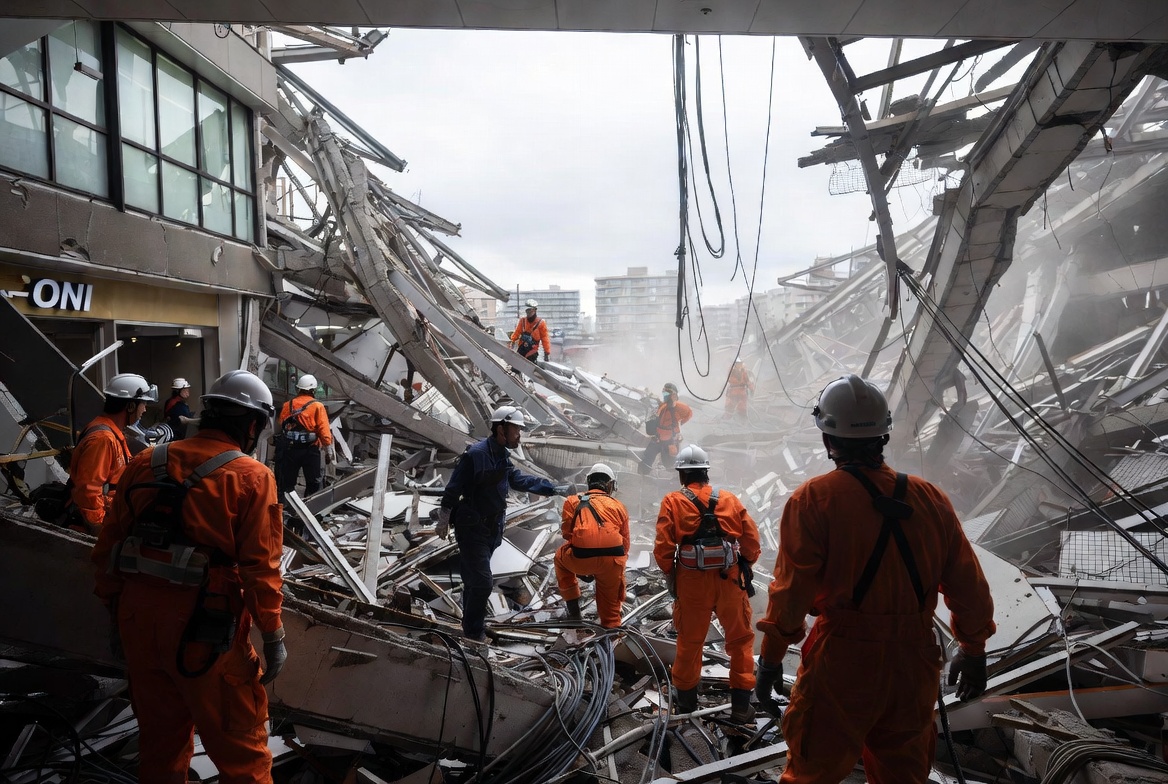

Japanese emergency teams worked hard on Thursday to find any last survivors trapped inside a ruined shopping mall as the death toll from a powerful earthquake climbed to 28.
Officials in Kumamoto said four bodies had been pulled from the wreckage of the Aeon Mall after a suspected gas explosion that followed Tuesday’s quake. Disaster management staff reported that ten people were recovered in total. Four were confirmed dead, one showed no vital signs, and five others suffered injuries ranging from severe to minor.
The 7.1-magnitude earthquake struck southern Japan and caused widespread destruction. Homes collapsed, bridges were damaged, fires broke out, and tens of thousands of people lost power and water. Temperatures are expected to reach 38 degrees Celsius this weekend, making conditions even harder for those without electricity or air conditioning.
Hundreds of elderly residents slept on thin mats spread across the hard floor of a community centre in Uki city. Japan has the world’s second-oldest population, and many older people struggled in the heat. One woman who preferred not to give her name said she was grateful for the shelters. She had tried staying at home or resting in her car but found the heat and mosquitoes too much to bear.
Supermarket worker Hiroyuki Matsushima, 53, a father of four, agreed. He said living without power and air conditioning in this weather is extremely tough.
The shopping mall had been emptied after the first tremor, but roughly fifty minutes later a massive blast tore through the building while an unknown number of staff remained inside. Businessman Fumihiko Matsuura, 56, said he had watched a movie there only a week earlier and felt he had narrowly escaped danger.
Rescue teams in orange overalls and white helmets carefully moved through twisted steel, dangling cables and fallen ceiling pieces. At a paper factory in Yatsushiro, five people were confirmed dead and four remained missing after part of a tall smokestack collapsed.
By Thursday morning around 22,670 households still had no electricity and about 84,000 homes lacked running water. People queued for petrol and drinking water while authorities delivered hundreds of air-conditioning units to shelters.
Japan sits on four major tectonic plates and experiences hundreds of tremors every year. Kumamoto itself suffered two deadly quakes in 2016 that killed 273 people. The country still remembers the 2011 disaster that claimed nearly 18,500 lives.