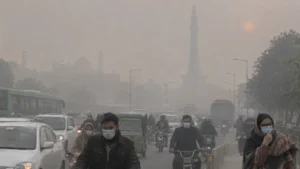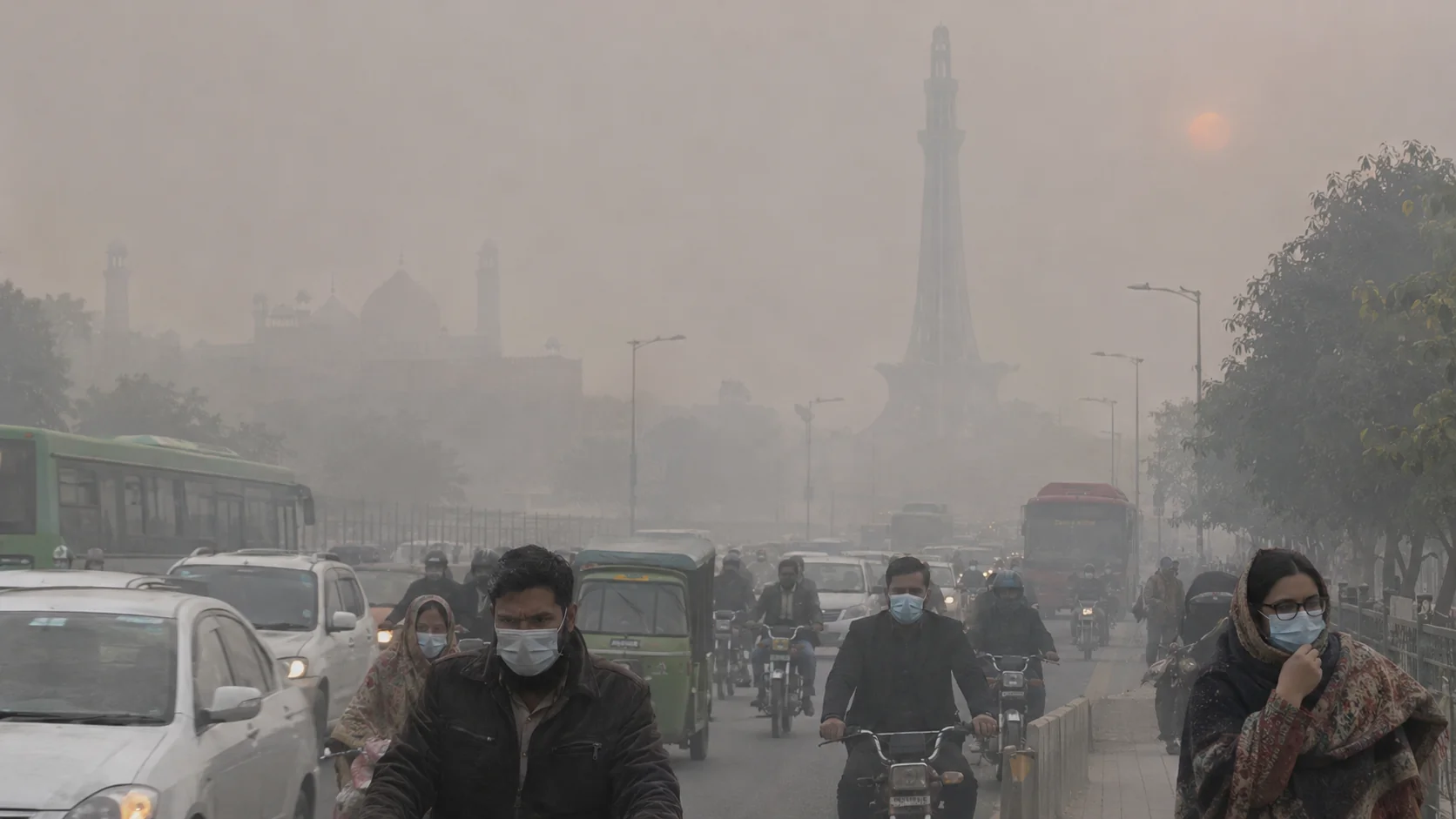

Lahore has once again claimed the unwanted title of the world’s most polluted major city. On Sunday morning between 9am and 10am, the city recorded a particulate matter reading of 538 according to the Swiss platform IQAir. Any reading above 300 falls into the hazardous category, meaning the air poses serious risks to people’s health.
India’s capital Delhi stood second with a reading of 207. Other cities in Punjab also showed alarming numbers. Bahawalpur reported 463, Sargodha registered 382, and Multan sat at 255. Thick smog has blanketed the region for days, cutting visibility and triggering widespread complaints of throat irritation, breathing trouble, and itchy eyes.
Every winter, cold air traps fine particles close to the ground across South Asia. Vehicle exhaust, factory emissions, construction dust, and crop residue burning all feed into the problem. Health experts warn that long-term exposure raises the risk of stroke, heart disease, lung cancer, and chronic respiratory illness for millions of people.
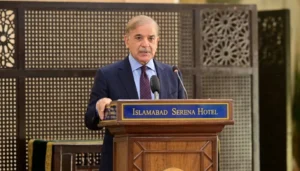
Punjab Senior Minister Marriyum Aurangzeb questioned the accuracy of IQAir’s data. She said the platform does not update readings in real time and that morning figures often stay displayed until noon. Speaking at a press conference in Lahore, she listed steps the provincial government has taken. Departments across Punjab are involved, water is being sprayed through smog guns in high-pollution zones, and 80 air quality monitors now operate across the province. Updated figures appear on the government’s own website.
Aurangzeb also pointed to low wind speeds and humidity as factors that worsen readings. She noted that earlier governments had not matched the current level of effort. Previously she had linked some of the pollution to fireworks during Diwali celebrations in India and said polluted air travels through the eastern corridor.
Both Pakistan and India have raised the shared air quality challenge at international forums. Officials on both sides acknowledge the scale of the problem yet the toxic haze returns each winter. Residents of Lahore and surrounding cities continue to face the health and daily-life impacts of this recurring crisis.