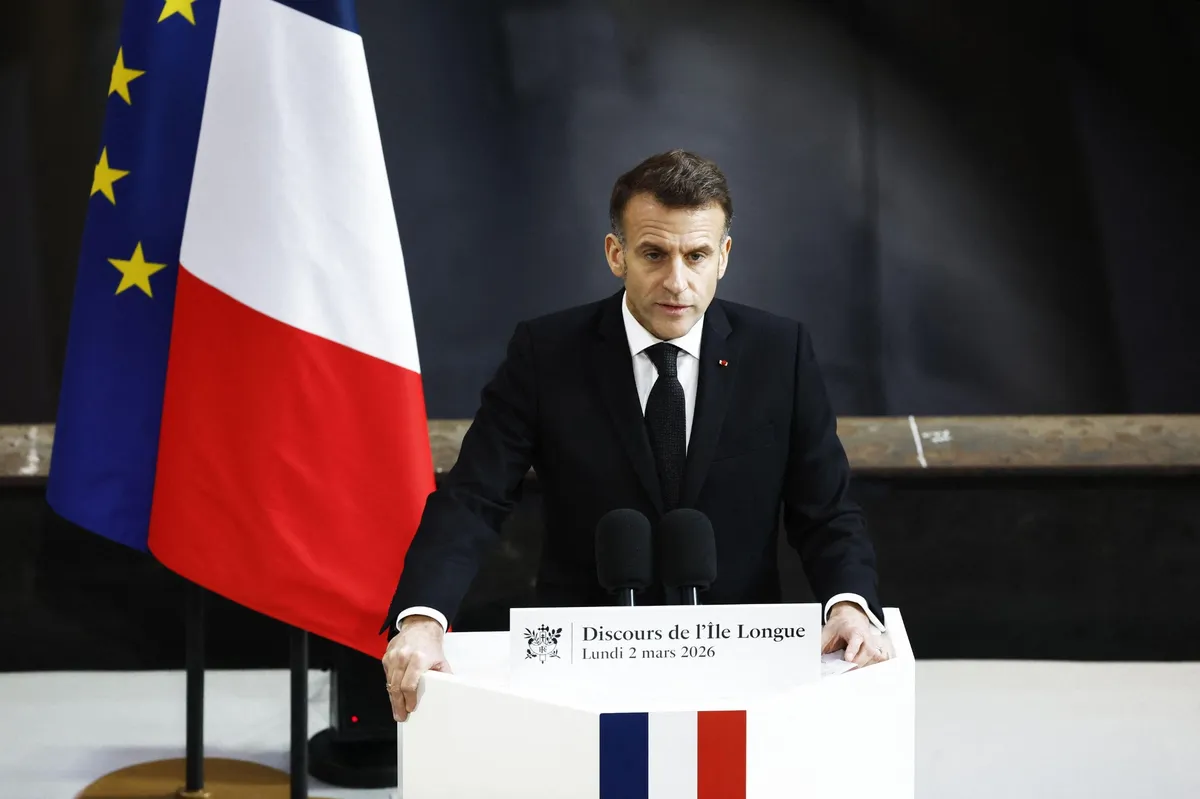

PARIS: French President Emmanuel Macron has announced a significant shift in France’s nuclear doctrine, signaling a stronger and more collaborative European nuclear deterrence strategy. Speaking at the naval base in Ile Longue, Crozon, Macron confirmed that France will expand its nuclear arsenal in response to rising geopolitical tensions and security uncertainties across Europe.
For decades, most European nations have relied heavily on the United States for nuclear protection under the transatlantic security framework. However, recent global developments, including changing US foreign policy dynamics and ongoing instability linked to the Ukraine war, have pushed European leaders to rethink their defense strategies.
Macron revealed that several European countries, including Germany, Poland, Greece, the Netherlands, Belgium, Denmark, and Sweden, will now be allowed to participate in French nuclear wargames. He also indicated that French strategic air forces could potentially be stationed deeper within the European continent under a new forward deterrence doctrine. Despite this expansion in cooperation, Macron emphasized that the final decision on any nuclear strike will remain solely with the French president.
In a joint statement, German Chancellor Friedrich Merz confirmed the creation of a France Germany nuclear steering group to strengthen deterrence coordination. Meanwhile, Polish Prime Minister Donald Tusk expressed support for deeper collaboration, describing it as a united effort to strengthen Europe’s defense capabilities.
France currently maintains around 290 nuclear warheads, making it the world’s fourth largest nuclear power. The country spends approximately 5.6 billion euros annually to maintain its nuclear forces. While France’s doctrine remains based on the principle of strict sufficiency, Macron confirmed that the number of warheads will increase to address emerging security challenges.
Macron also reassured allies that France will maintain close cooperation with Britain, and that its updated strategy complements NATO’s nuclear mission, ensuring transparency with Washington.