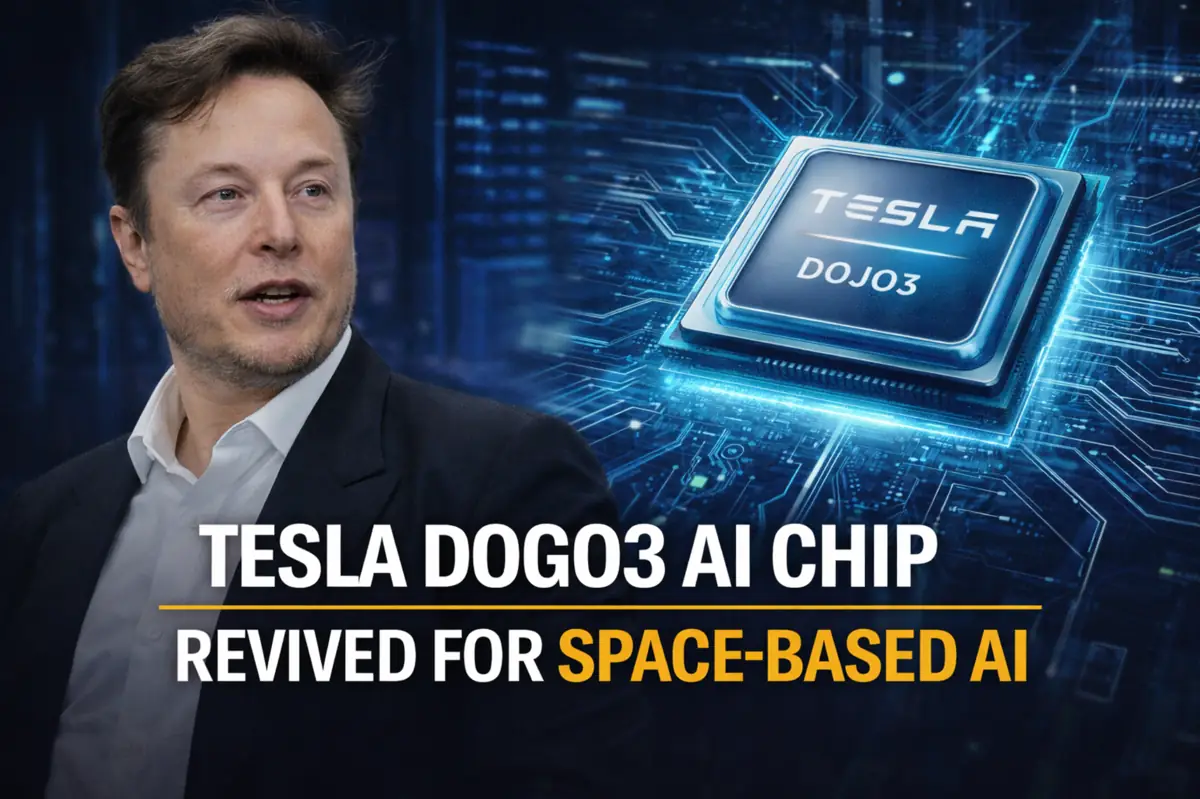
Interest in the Tesla Dogo3 AI chip has surged after Elon Musk revealed fresh details about the revival of Tesla’s previously abandoned Dojo3 project. Shelved initially last year, the third-generation AI chip is now set to return with a completely different mission, focusing on space-based AI compute rather than training self-driving systems on Earth.
Tesla shut down the Dojo program about five months ago, dissolving the core team after the exit of Dojo project head Peter Bannon. Following the shutdown, nearly 20 Dojo engineers left Tesla to join DensityAI, a new AI infrastructure company founded by former Dojo leader Ganesh Venkataramanan, along with ex-Tesla engineers Bill Chang and Ben Floering.
At the time, reports suggested Tesla was stepping back from custom chip development and increasing reliance on external partners like Nvidia, AMD, and Samsung for AI compute and manufacturing needs. However, Musk’s latest comments signal a strategic shift rather than a complete retreat from in-house silicon development.
Posting on X, Musk explained that Tesla’s internal roadmap for AI chips is now stronger than before. He stated that the AI5 chip, which currently powers Tesla’s whole self-driving systems and Optimus humanoid robots, is in good shape. TSMC produces the AI5 chip, while Tesla has already signed a $16.5 billion agreement with Samsung to manufacture the upcoming AI6 chips.
According to Musk, AI7, also known as Dojo3, will be designed explicitly for space-based AI computation, an ambitious concept that aligns with his long-term vision of advanced computing beyond Earth. He also issued an open call to engineers, inviting them to work on what he described as potentially the highest volume AI chips in the world.
While details about how space-based AI computing will be deployed remain unclear, the announcement fits Musk’s established pattern of introducing bold ideas and pushing technological boundaries. The revival of the Tesla Dogo3 AI chip suggests that Tesla is not done innovating at the silicon level and may once again aim to compete directly in the AI hardware space.