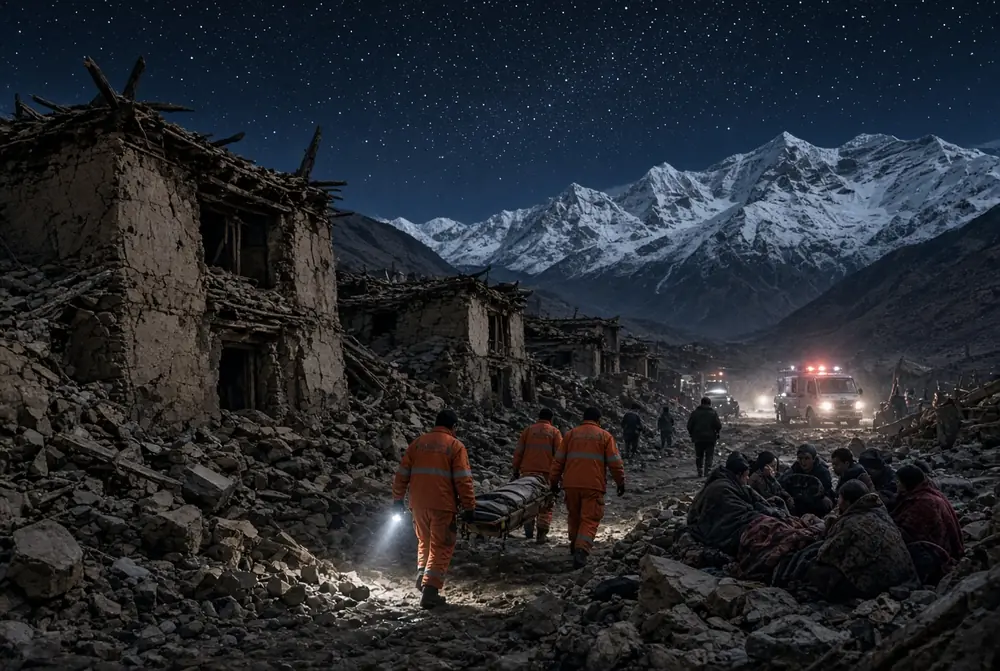

A powerful magnitude 7 earthquake struck China’s Tibet region on Thursday night, leaving at least 16 people dead and 32 others injured. State news agency Xinhua reported the figures based on information from Nagqu City’s emergency management bureau.
As of early Friday morning, 11 of the injured were in serious condition while 21 had sustained minor injuries. Local authorities confirmed that at least two people were hurt in a village close to the epicentre. Several houses in the nearest settlements developed cracks after the strong tremors.
The quake hit a sparsely populated high-altitude county in northern Tibet at a depth of about 10 kilometres. The average elevation around the epicentre reaches nearly 4,864 metres. It was the strongest earthquake to strike China since January 2024. The epicentre lay roughly 400 kilometres from the Tibetan capital Lhasa.
Videos shared by local media showed residents rushing out of their homes and seeking safety on the streets or inside parked cars. One person described being woken by the intense shaking and hearing the house creak during the tremor. The China Earthquake Networks Centre confirmed that the quake was clearly felt across the local area.
Fire and rescue teams have already been mobilised and are moving toward the affected region. A series of smaller aftershocks measuring around magnitude 3 and 4 followed the main tremor in surrounding areas.
The remote and rugged nature of the region poses extra challenges for rescue operations. High altitude and limited road access can slow the arrival of emergency services and medical support. Authorities are working quickly to assess the full extent of the damage and reach isolated communities.
This latest disaster brings back memories of the devastating 2010 magnitude 7.1 earthquake in neighbouring Qinghai province that claimed thousands of lives. Officials in Tibet are now focused on providing immediate help to the injured and ensuring that people have safe places to stay while aftershocks continue.
Emergency workers continue to search for anyone who may still be trapped or in need of assistance. The priority remains saving lives and preventing further harm in the cold high-altitude environment. Residents have been advised to stay outdoors or in open areas until the situation stabilises.
The earthquake has once again highlighted the seismic risks faced by communities living on the Tibetan Plateau. Continuous monitoring and rapid response remain essential as aftershocks are still being recorded.