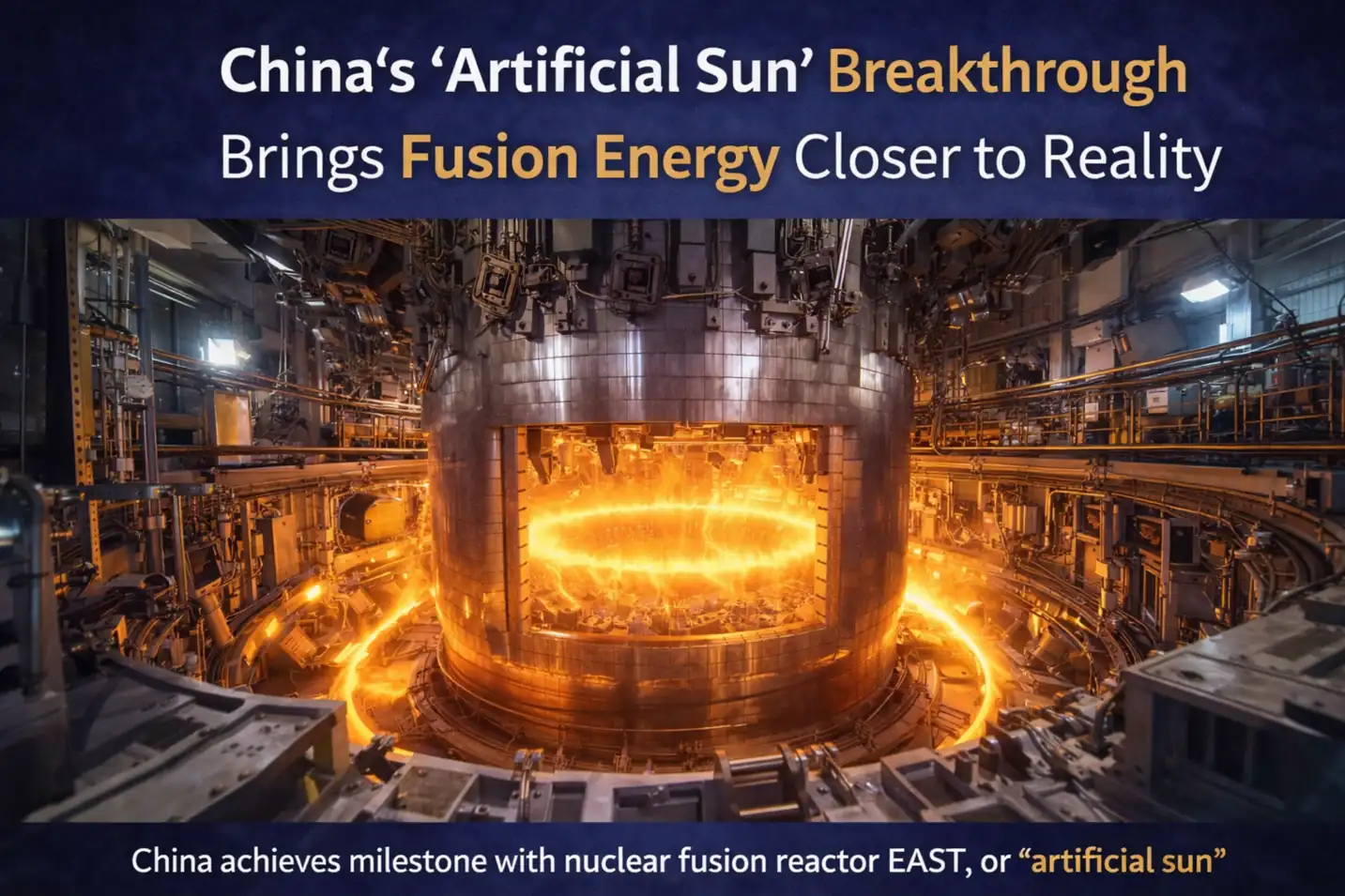

China has achieved a significant milestone in its pursuit of nuclear fusion energy, bringing the world closer to a future powered by clean and near-limitless energy. The country’s nuclear fusion reactor, widely known as the artificial sun, has successfully pushed plasma stability beyond previously accepted limits.
According to the Chinese Academy of Sciences, the Experimental Advanced Superconducting Tokamak, or EAST, managed to maintain plasma at extremely high densities while remaining stable. This breakthrough addresses a long-standing challenge that scientists believed was a significant barrier to advancing fusion technology.
A study published in the journal Science Advances on January 1, 2026, explained that the development offers a new pathway for extending plasma density limits in future fusion reactors. Researchers say this progress could help improve the performance and efficiency of next-generation fusion devices.
Professor Ping Zhu from the University of Science and Technology of China described the findings as a practical and scalable pathway toward achieving sustainable fusion energy. Experts highlight that nuclear fusion produces energy without greenhouse gas emissions or long-lived radioactive waste, making it a promising alternative to fossil fuels.
Despite the optimism, scientists caution that fusion energy alone cannot solve the current climate crisis. The technology remains in an experimental stage, and existing reactors often consume more energy than they generate. China’s artificial sun has also not yet achieved fusion ignition, where the reaction becomes self-sustaining.
Even so, researchers believe this progress places humanity closer to a future energy source that could transform global power generation.