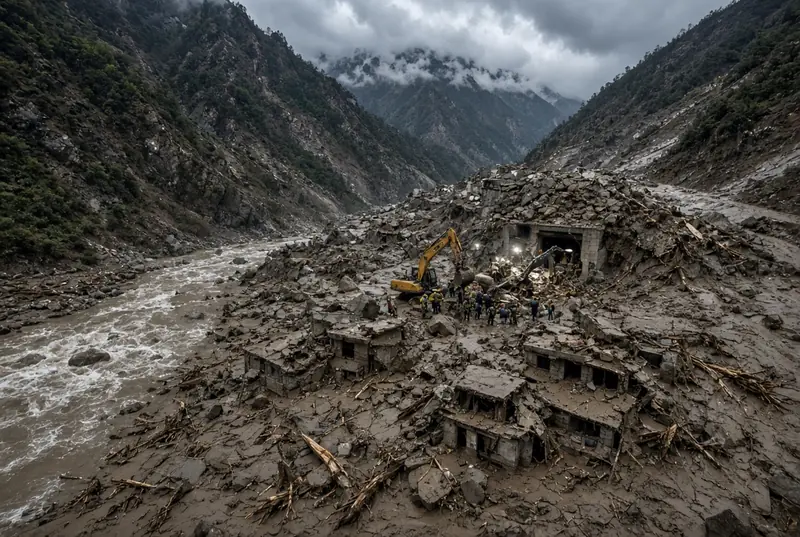

Nepal floods have left hundreds of workers trapped inside hydropower tunnels as rescue teams race against time. Last week’s massive Himalayan disaster, triggered by a glacier collapse on the Nepal-Tibet border, sent ice, rock, mud and debris roaring through valley towns and villages. The death toll has now crossed 900, with nearly 5,000 people still missing. On the Chinese side, 16 lives were lost and hundreds more remain unaccounted for.
Nepali officials report that 933 workers are missing from several hydropower projects in the worst-hit region. Many tunnels are completely blocked by thick layers of mud and rock. Soldiers and earth-moving machines worked through the night under bright lights, digging deep pits and carefully clearing debris in the hope of finding survivors. Army spokesperson Raja Ram Basnet said the top priority is opening those tunnels as quickly as possible.
The Red Cross estimates more than 90,000 people have been affected. Hundreds of unidentified bodies have already been buried in shallow graves because the humid weather is causing rapid decomposition. Nearly 21,000 security personnel, along with civilian volunteers, are involved in the massive search and rescue effort.
Prime Minister Balendra Shah described the event as an unprecedented natural disaster and admitted that a full damage assessment remains extremely difficult. China has sent experts and equipment, while India is also assisting with specialised tunnel-rescue knowledge. Beijing has mobilised over 2,100 rescue workers and allocated significant funds for relief.
Fresh risks continue to worry authorities. A new lake formed by landslide debris has largely drained, but another crater near the original glacier collapse now holds a large volume of water. Officials warn that any sudden breach could trigger further flooding downstream. Eight high-risk landslide zones have also been identified along the river.
Chinese state media linked the glacier collapse to long-term global warming effects on the Tibetan plateau. Two Nepali officials expressed concern that limited data sharing from China on glacier risks could make future preparedness harder. Despite bad weather and ongoing dangers, rescue teams remain determined to reach everyone still trapped.